


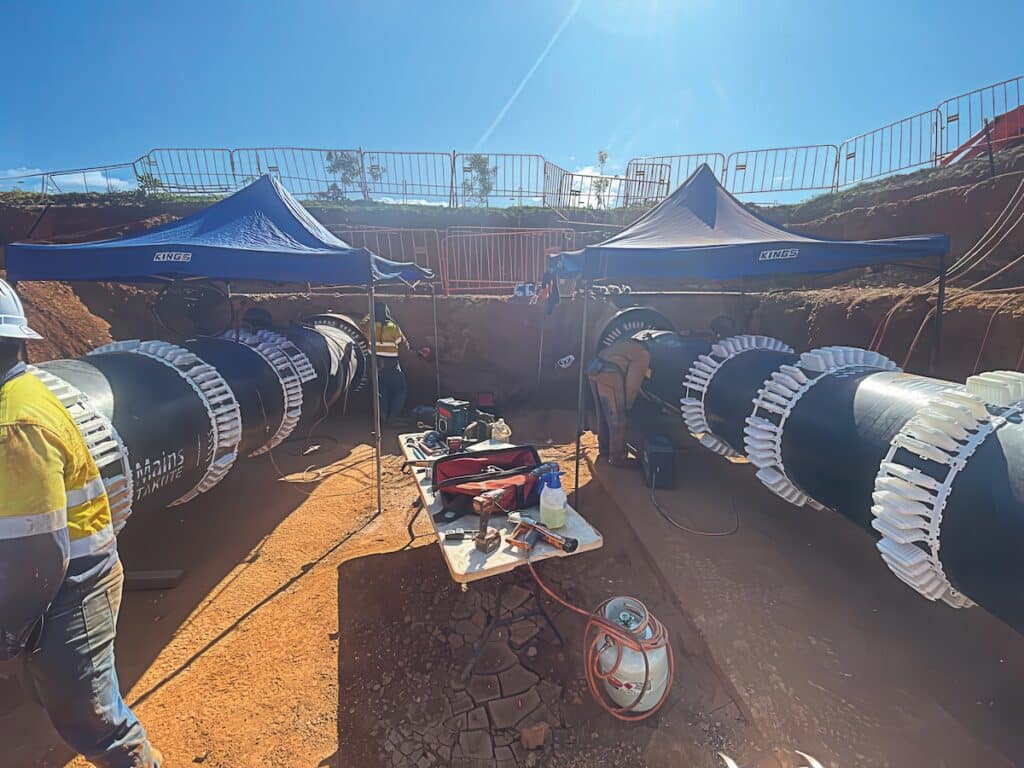
kwik-ZIP has demonstrated its flexibility on the Cairns water security project.
Like many cities around Australia, the population of Cairns is growing – and utilities must keep pace. Copperlode Falls Dam is Cairns’ main drinking water supply, but it was built in 1976 when the population numbered just 58,000 people. The city’s population has tripled since then and is expected to hit over 240,000 by 2050. Against this backdrop the regional council launched the Cairns water security stage one project, aimed at securing ample drinking water supply for many years to come.
Stage one of the project involves the construction of a water intake at the Mulgrave River, near the Desmond Trannore Bridge in Gordonvale; a water treatment plant and water reservoirs on council land; and a network of pipes to take raw water to the treatment plant and treated water from the plant to residents.
At a glance, the water will move through the riverbank to the intake pumps being filtered through the sand and gravel as it goes. This type of intake is designed to minimise impacts to the environment. The water will then be piped from the river, along with water from the existing intake at Behana Creek, to the new water treatment plant where it will be treated and stored ready for drinking.
Australian company kwik-ZIP played an important role in the construction of the project by providing various models of pipeline spacers used on various sections. These spacer systems help to facilitate the slip-lining of pipelines and protect carrier pipes from threats such as ground movement, corrosion, abrasion, and much more.

“It was a meaningful project for us to play a role in,” kwik-ZIP General Manager Paul Jeffreys told The Australian Pipeliner.
“When everything is up and running, the project will provide modern, integrated and long-term water security for the people of Cairns.
“The project had several different crossings with specific requirements, but with kwik-ZIP’s range of models and availability of different runner heights, we were able to find and supply a solution for all project requirements. Three different models of spacers were supplied for the project.”
kwik-ZIP’s products are approved for use within many utilities’ infrastructure, including Melbourne Retail Water Association, South-East Queensland’s Infrastructure and Materials list, Sydney Water, and the WA Water Corporation. All products are certified by the Australian Water Quality Centre for use in contact with drinking water.
Engineered from a high-performance thermoplastic blend, they are highly resilient and include integrated rubber grip pads to prevent slippage, eliminating the need for pipe pre-wrapping.
The modular design of these spacers can also accommodate a wide range of pipe diameters.
Low friction and abrasion resistance is a staple of all kwik-ZIP spacers that allows for longer run lengths and lower insertion forces. This reduces the size of machinery needed for installation, saving energy, money, and valuable space on-site. Pair this with the fact that kwik-ZIP products are simple to install without the requirement of any special tools, and it’s easy to see why the company is a go-to choice for major infrastructure works like the Cairns water security project.
“Everyone deserves clean, secure water. We know just how important this project is for this growing region,” former Minister for the Environment and Water Tanya Plibersek said at the time of the project’s announcement.
“This isn’t just essential for the people who live in Cairns, but also for the industry who rely on the area. It’s good for Cairns, and good for Queensland.”
Once operational, the project is expected to provide approximately 6.4 gigalitres of extra water to the region each year, which is a quarter of Cairns’ current annual use. The $472 million project is jointly funded by the Australian and Queensland Governments and delivered in partnership with Cairns regional council. It is expected to be completed by mid-2026.

For more information, visit the website.

