a philosophaster dabbles. sometimes serious, other times not.
a philosophaster takes their time, and resists sloppy and hurried thinking, but at the same time, seeks out vagueness and uncertainty...
the internet is a fast place. but not only the internet, the world is hyper-accelerated: travel, communication, food, publishing, fast production generally. at philosophasters we offer ourselves, and whoever is interested, strategies and therapies for slowing down and reclaiming thought.
through our interviews, articles, collections, blasters, dialogues, retreats and public events we seek both free and playful exploration, but also careful peregrinations. our goal is to make philosophical, scientific and artistic ideas part of common discourse. our podcast and articles are about making connections. thus, it is essential to present ideas and people that reach across diverse and often fragmented disciplines; we focus on words, research, and art that builds bridges and resists the push towards specialization, while at the same time not skating around complexity and subtlety of thought.
our projects grow from the inside, they happen by planting seeds. the site's content emerges organically; a result of the shared experience of the philosophaster community. we don't follow production schedules, or fill space to fill space, talk for the sake of talking. all our content (editor commissioned, or writer-submitted) and events are a horticultural undertaking: some of these grow into new projects and events, and some do not. we always take each new seedling seriously. they've all made it here for a reason, however vague, and for this simple truth they deserve our attending to.
we work in a variety of mediums, because well, quite simply, ideas come in many forms, not just academic papers. philosophasters is not committed to any particular subject matter, but simply the praxis of philosophizing, wherever that may take us, and in whatever form.
philosophasters is produced by the New Curriculum Group.
“European culture’s post-Cartesian proclivity for a certain form of knowing, a certain form of what many take to be cognitive rigour, has caused the closing down of the contemplative tradition in European thought. This has meant, because of the pedagogical attachments that mark this seemingly lost tradition, that conversation, attention, interior transformation have undergone a complete loss of philosophical significance. It is not surprising that settler culture does not comprehend where and what home is, since it does not know how to see, to take in, individualities and their relationships.”
Tim Lilburn is a Canadian poet, philosopher, and essayist — from Saskatchewan, and a longtime West Coast resident (Victoria).
What is semiotics and what has it got to do with the history of Philosophy? In this feature length interview, Winfried Nöth details the close relationship between the doctrine of signs and Western Philosophy.
Lawrence Paul Yuxweluptun is a generous man—generous with his time, his space, and his thoughts. I’ve long admired his paintings, and often wanted to say hello to him when I see him in the street. He was quick to answer our request to interview, and we spent a good four hours on his Main street studio looking at his canvasses and imagining the paintings for the stories which he proceeded to share.
Tim Ingold explores the entangled relations between human beings and the environments they inhabit. Over the last 30 years, he has written and taught widely on how embodied processes of enskillment (learning to hunt-fish-forage, weave or sing, making and expressing art and craft alike) fundamentally determine and shape the diverse ways in which we perceive, understand, and 'dwell' in the world.
What does Tarot, educational philosophy, semiotics, and Jungian approaches to the unconscious have to do with one another? The answer is Inna Semetsky.
Alin Olteanu is a scholar who takes 'learning' very seriously. We got to talking to Alin about many things, including: the shared history of semiotics and liberal education; Christian and Islamic philosophy; intercultural translation; the close affinity between biology and learning; and how our social understandings of learning determine and shape our basic relationship to the world.
We got to talking with Danesi about how he first came to "the way of signs", some of his important texts, the future of the discipline, and the need for semiotics in the world today.
The year 2115: dissatisfied with what he feels to be a half-baked answer to his question ‘what is lithium?’, the student Simplicio poses his personal educational computer (Charles Sanders Personal) a series of questions on the nature of inquiry and the conditions of knowing and knowledge generally.
In this interview with scientist and philosopher Mihai Nadin, we discuss how we can define and understand living organisms as anticipatory systems. This brings up a discussion on the need and role for semiotics (as fundamental [meta]science) in scientific/philosophical research.
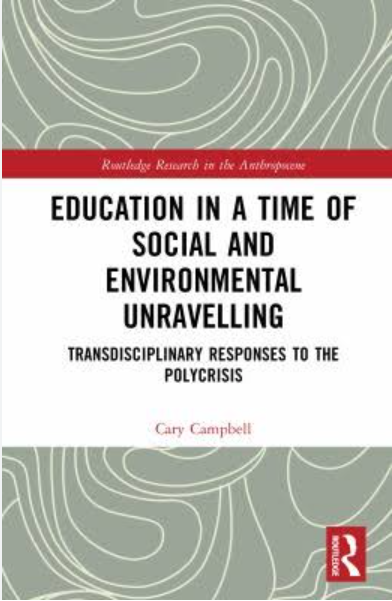
A short blurb about Cary Campbell’s new book Education in a time of Social and Environmental Unravelling
This review by Cary Campbell of Robert Bringhurst & Jan Zwicky’s (2019) Learning to die: wisdom in the age of climate crisis, was originally published in issue #86 (Summer 2020) of subTerrain magazine. We are republishing it here (with minor additions/changes).
“Part of adopting a literary perspective to the practice of philosophizing, involves some new concepts. Personally, I’m attracted to the Russian-American linguist Roman Jacobson’s (somewhat out of fashion) conception of ‘literariness’ in place of the more absolute designation ‘literature. The advantages I see in this concept is in the turning away from literature as being tethered to a concrete work or text. It is an appropriation of literature as a philosophical value to be found in anything.”

This 2023 interview with Canadian, poet, philosopher and essayist Tim Lilburn was initially commissioned for a Special Issue of the Journal of Contemplative & Holistic Education.
Lilburn discusses with Cary Campbell, the general dilemma of ‘how to be here’ – both: how to connect to land and place as a member of settler society, as well as; how to inhabit this moment of acute climate crisis – discussing ideas from Lilburn’s (2017) previous book The Larger Conversation: Contemplation and Place, and his recent Numinous Seditions: Interiority & ClimateChange. This interview follows up from an earlier dialogue between Lilburn and Campbell, published by Philosophasters.org in 2019.