![[sticky entry]](/%20https://www.npmjs.com/package/ocr-https-www.dreamwidth.org/img/silk/entry/sticky_entry.png)
It's time for a new sticky post to track my outings this year. Links will be added as the outings are written up. Most will remain open, but some may be friends only.
Coming up:
6th January: Marie Antoinette Style - V&A
13th January: The Wallace Collection - Caravaggio's Cupid and the Swords of Lucknow
16th January: London Transport Museum, Acton guided tour
13th February: Walking tour - Diverse London, City Public Art by Refugees and Immigrants
18th February: Samurai - The British Museum
25th March: Turner and Constable - Tate Britain
4th March: Courtauld Art Gallery: Seurat and the Sea
16th March: U3A guided tour: The Holbein staircase at Bart's Hospital
18th March: U3A guided tour: Women in the National Portrait Gallery
20th March: Museum of Brands and Thunderbirds Exhibition
1st April: Konrad Mägi exhibition Dulwich Picture Gallery
9th April: Peak Freans Musum
23rd April: Tulley's Tulip Fest
24th April: Young V&A: Aardman Animations
7th May: Michaelina Wautier exhibition at the RA
14th May: National Gallery: Zurbarán exhibition, Stubbs exhibition and Courtauld Landscapes by lady artists.
9th June: Perspicere's thread craft creations at the Saatchi Gallery and The Cutlery Exhibition at The Goldsmith Centre
16th June: James McNeil Whistler exhibition: Tate Britain
1st July: Visit to Waddesdon Manor
14th July: Visit to Highclere Castle: Home of Downton Abbey
Question a day meme:
January questions are here
February questions are here
March questions are here
April questions are here
May questions are here
June questions are here
July questions are here
August questions are here


An outing to see a miniature!
Jul. 20th, 2026 05:42 pmToday we went to Leighton House, the former residence of Lord Frederic Leighton (1830-1896), the renowned painter and sculptor, which is in Kensington, London. The house was built between 1866 and 1895, and it had an extension on the left-hand side in 1869–70 and was added to again in 1889.
The house only had one bedroom, as it was chiefly used as a studio for Leighton to paint, discuss commissions with clients, entertain his friends and fellow artists and display his artwork. Consequently, on his death, it was very difficult to sell the property, and it was first opened to the public in 1929.
We've both been to Leighton House many times, and I've probably been slightly more often than Mr Cee, as I've been to see a lot of exhibitions. The reason we went today is that they had a 1/12th scale model of the house, highlighting three of the main decorative rooms, including the fantastic Arab Hall, the Narcissus Hall, the staircase and the Silk Room. The model must have cost thousands to make, and this was the last day it was available to see, having been on loan for a few days.
Under the cut are photos of the model and some of the same rooms we looked around in the actual house.
( Read more... )
We couldn't even speculate how much it cost to produce such an artwork. The model makers are Mulvany and Rogers, who have been making models of historic houses for 30 years. You can see more of their astonishing work on their website.
In addition to the tour and the chance to see the model of Leighton House, we also saw a small exhibition of what inspired Frederic Leighton to create the Arab Hall in the first place. A few photos under the cut.
( Read more... )
It was a fabulous visit, and we really enjoyed learning more about the Arab Hall and seeing such a wonderful model of Leighton House. We enjoyed a fabulous lunch in a nearby restaurant and then headed home in the sunshine!
The house only had one bedroom, as it was chiefly used as a studio for Leighton to paint, discuss commissions with clients, entertain his friends and fellow artists and display his artwork. Consequently, on his death, it was very difficult to sell the property, and it was first opened to the public in 1929.
We've both been to Leighton House many times, and I've probably been slightly more often than Mr Cee, as I've been to see a lot of exhibitions. The reason we went today is that they had a 1/12th scale model of the house, highlighting three of the main decorative rooms, including the fantastic Arab Hall, the Narcissus Hall, the staircase and the Silk Room. The model must have cost thousands to make, and this was the last day it was available to see, having been on loan for a few days.
Under the cut are photos of the model and some of the same rooms we looked around in the actual house.
( Read more... )
We couldn't even speculate how much it cost to produce such an artwork. The model makers are Mulvany and Rogers, who have been making models of historic houses for 30 years. You can see more of their astonishing work on their website.
In addition to the tour and the chance to see the model of Leighton House, we also saw a small exhibition of what inspired Frederic Leighton to create the Arab Hall in the first place. A few photos under the cut.
( Read more... )
It was a fabulous visit, and we really enjoyed learning more about the Arab Hall and seeing such a wonderful model of Leighton House. We enjoyed a fabulous lunch in a nearby restaurant and then headed home in the sunshine!
An outing to a party house
Jul. 3rd, 2026 11:19 amOn Wednesday, we went on a coach trip to visit Waddesdon Manor in Aylesbury, near Oxford, which was built by Baron Ferdinand de Rothschild (1839-1898) between 1874 and 1885 in the French Renaissance style. The area was known as Rothchildshire because the family already owned so many properties there, and this house was specifically designed to showcase the antiques and collectables that Ferdinand showed to his guests during lavish summer house parties. Weekend parties would start on Saturday and end on Monday when Ferdinand returned to London and included royalty amongst the guests.
Owned by the Rothschild family up until 1957, the manor was bequeathed to the National Trust. Currently, Dame Hannah Rothschild (British filmmaker, author, and philanthropist) is the chair of the Rothschild Foundation, managing and caring for Waddesdon.
It's a very impressive place, and Wednesday had particularly dramatic skies to show it off:

Every room was decorated with French architectural features and filled with art collections. There was a LOT to see, including furniture, panelling, plaster work, chandeliers, jewellery, paintings, sculptures and more - and so there are quite a few photos of my favourites under this cut...
( Read more... )
It was a fascinating place, and we spent nearly three hours wandering around and didn't even get time to see the gardens. We shall definitely visit another day. If you want to explore more about the house and the story of the Rothschilds, there is a lot of information on the Waddeston Manor website here. If you want to see more of the collections, click here.
Owned by the Rothschild family up until 1957, the manor was bequeathed to the National Trust. Currently, Dame Hannah Rothschild (British filmmaker, author, and philanthropist) is the chair of the Rothschild Foundation, managing and caring for Waddesdon.
It's a very impressive place, and Wednesday had particularly dramatic skies to show it off:

Every room was decorated with French architectural features and filled with art collections. There was a LOT to see, including furniture, panelling, plaster work, chandeliers, jewellery, paintings, sculptures and more - and so there are quite a few photos of my favourites under this cut...
( Read more... )
It was a fascinating place, and we spent nearly three hours wandering around and didn't even get time to see the gardens. We shall definitely visit another day. If you want to explore more about the house and the story of the Rothschilds, there is a lot of information on the Waddeston Manor website here. If you want to see more of the collections, click here.
Under the cut for the August daily questions. The list of questions available can always be found in my sticky post.
( Read more... )
( Read more... )
Whistler's Mother and other art
Jun. 18th, 2026 09:34 amOn Tuesday, I went to the Tate Britain in London to see their exhibition of the American artist James McNeill Whistler. The exhibition has 190 works from Whistler's 50-years of painting, drawing, printmaking and design. Born in the United States and raised in Russia, Whistler (1834–1903) worked across four continents.
He was often at odds with other artists and was involved in libel cases defending his artistic style.
You are greeted by this painting at the beginning of the exhibition - The Artist in his Studio (1865–6). James Whistler in his studio along with artist Joanna Hiffernan and professional model Emelie Jones, who are relaxing in loose Japanese robes. A display of blue and white ceramics behind them signals Whistler’s interest in East Asian art.

More photos under the cut (don't worry, there aren't 190!)
( Read more... )
Whistler died in London in 1903, aged 69, and is buried in Chiswick Old Cemetery in west London, adjoining St Nicholas Church.
I've barely touched the surface in this post of the many and varied items in the exhibition, which is well worth a visit. It closes at the end of September this year.
He was often at odds with other artists and was involved in libel cases defending his artistic style.
You are greeted by this painting at the beginning of the exhibition - The Artist in his Studio (1865–6). James Whistler in his studio along with artist Joanna Hiffernan and professional model Emelie Jones, who are relaxing in loose Japanese robes. A display of blue and white ceramics behind them signals Whistler’s interest in East Asian art.

More photos under the cut (don't worry, there aren't 190!)
( Read more... )
Whistler died in London in 1903, aged 69, and is buried in Chiswick Old Cemetery in west London, adjoining St Nicholas Church.
I've barely touched the surface in this post of the many and varied items in the exhibition, which is well worth a visit. It closes at the end of September this year.
An outing with threads and cutlery...
Jun. 10th, 2026 12:31 pmYesterday, Mr Cee and I decided to brave the heavy rain showers and visit a couple of free exhibitions in London. We started by going to the Saatchi Gallery to catch Perspicere: States of Transition before it closes at the weekend.
Perspicere is a street artist who uses sewing thread wound around nails to form pictures. These aren't the nail and thread pictures you might remember from the 1960s and 1970s - these are stunning works of art produced with thousands of threads like this:

More amazing thread art under the cut (including a link to a short video on how he does it).
( Read more... )
We also popped into the small Inflorescence exhibition in a next-door room to check out this fun wall of smilie flowers by RYCA (aka Ryan Callanan)

From there, we jumped on the tube to head for The Goldsmith Centre in Islington to see their small free exhibition The Culture of Cutlery. The display covers European cutlery from 1425 to the present day. It's easy to forget that cutlery was not always provided by the host, and back in the medieval or Renaissance era, guests would bring their own knife, even if the spoon was provided by the host. Knives would be used to spear meat and take salt from the saltcellar. More under the cut about the history (including when forks started to be used) with photos (which get bigger with a click) under the cut.
Knife and fork with their travelling case from 1577, with figures carved on the handles. (from Germany or the Netherlands).

( Read more... )
It was a fun outing, and we managed to completely miss the downpour of heavy rain while we were inside looking at things (which was a bonus).
Perspicere is a street artist who uses sewing thread wound around nails to form pictures. These aren't the nail and thread pictures you might remember from the 1960s and 1970s - these are stunning works of art produced with thousands of threads like this:

More amazing thread art under the cut (including a link to a short video on how he does it).
( Read more... )
We also popped into the small Inflorescence exhibition in a next-door room to check out this fun wall of smilie flowers by RYCA (aka Ryan Callanan)

From there, we jumped on the tube to head for The Goldsmith Centre in Islington to see their small free exhibition The Culture of Cutlery. The display covers European cutlery from 1425 to the present day. It's easy to forget that cutlery was not always provided by the host, and back in the medieval or Renaissance era, guests would bring their own knife, even if the spoon was provided by the host. Knives would be used to spear meat and take salt from the saltcellar. More under the cut about the history (including when forks started to be used) with photos (which get bigger with a click) under the cut.
Knife and fork with their travelling case from 1577, with figures carved on the handles. (from Germany or the Netherlands).

( Read more... )
It was a fun outing, and we managed to completely miss the downpour of heavy rain while we were inside looking at things (which was a bonus).
Under the cut for the July questions! All question sets for each month can be found in my sticky post, which can be found here.
( Read more... )
( Read more... )
Art everywhere, all at once!
May. 17th, 2026 12:26 pmOn Thursday, I went to three exhibitions in London as they were all very close to each other, and I had nothing better to do.
My first trip was to the National Gallery, where they have an exhibition of the Spanish painter Zubarán's amazing work. Francisco de Zurbarán was born in 1598 and was sent to Seville by his father to study art in 1614. His father was a haberdasher, and this must have influenced the young Zurbarán, as his attention to detail when painting fabric is really wonderful. His focus was mostly on religious paintings, but the exhibitions also included some still-life paintings created by himself and his son.
Under this cut for my favourites (with a few close-ups just because).
( Read more... )
From there, I went to a very small exhibition at the National Gallery about the painter George Stubbs and his work studying the anatomy of horses. He produced engravings of his drawings, which formed a treatise (with a very long title!), The Anatomy of the Horse. Including a particular description of the bones, muscles, fascias, ligaments, nerves, arteries, veins and glands. In eighteen tables, all done from nature (1766). It was recognised as the most accurate study of a horse's anatomy. His work allowed him to paint incredibly anatomically accurate horses.
Just a couple of horse-related photos under this cut.
( Read more... )
Finally, I walked to the Courtauld Gallery to see their exhibition: A View of One's Own: Landscapes by British Women Artists (1760-1860) as it was about to close. Women artists of this time were very limited in where they could train, but despite this, many still worked and exhibited their paintings and drawings. Many were supported by their families, but others struggled against the obstacles imposed by fathers and husbands.
A few of the landscapes under this cut.
( Read more... )
After all that, I headed home. Apologies for the very long post and many photos - feel free to scroll on past :D
My first trip was to the National Gallery, where they have an exhibition of the Spanish painter Zubarán's amazing work. Francisco de Zurbarán was born in 1598 and was sent to Seville by his father to study art in 1614. His father was a haberdasher, and this must have influenced the young Zurbarán, as his attention to detail when painting fabric is really wonderful. His focus was mostly on religious paintings, but the exhibitions also included some still-life paintings created by himself and his son.
Under this cut for my favourites (with a few close-ups just because).
( Read more... )
From there, I went to a very small exhibition at the National Gallery about the painter George Stubbs and his work studying the anatomy of horses. He produced engravings of his drawings, which formed a treatise (with a very long title!), The Anatomy of the Horse. Including a particular description of the bones, muscles, fascias, ligaments, nerves, arteries, veins and glands. In eighteen tables, all done from nature (1766). It was recognised as the most accurate study of a horse's anatomy. His work allowed him to paint incredibly anatomically accurate horses.
Just a couple of horse-related photos under this cut.
( Read more... )
Finally, I walked to the Courtauld Gallery to see their exhibition: A View of One's Own: Landscapes by British Women Artists (1760-1860) as it was about to close. Women artists of this time were very limited in where they could train, but despite this, many still worked and exhibited their paintings and drawings. Many were supported by their families, but others struggled against the obstacles imposed by fathers and husbands.
A few of the landscapes under this cut.
( Read more... )
After all that, I headed home. Apologies for the very long post and many photos - feel free to scroll on past :D
A little known Dutch artist
May. 7th, 2026 04:16 pmToday I braved the cold winds and possible rain to visit the Michaelina Wautier exhibition. Probably born 'Michelle' in the Spanish Netherlands around 1614, very little is known about her life, as many of the relevant documents we know existed (such as her will) have been destroyed. She was a trailblazer for women artists as she not only painted beautiful flower paintings, but also portraits, scenes from everyday life and history paintings showing religious and mythological subjects.
Women artists at the time were very restricted in what they could do, as they were prevented from attending formal art training. Fortunately, Michaelina's older brother was a painter, and it is likely he taught her, and they may have had a studio together for some years. During her lifetime, it is thought she was as famous as her contemporary Artemisia Gentileschi, but she has been forgotten for nearly three centuries, with many of her works being attributed to others (and in some instances, her name was painted over on her paintings!).
More of her works are being discovered all the time, including this set of five paintings: The Five Senses: Painted in 1650, these were only rediscovered in 2019 at an auction and are shown for the first time. More about these (and close-ups), and other lovely paintings, under the cut.
( Read more... )
It was a really interesting exhibition, and well worth a visit to see an artist who is still having new works discovered and attributed to her skill as a painter.
Women artists at the time were very restricted in what they could do, as they were prevented from attending formal art training. Fortunately, Michaelina's older brother was a painter, and it is likely he taught her, and they may have had a studio together for some years. During her lifetime, it is thought she was as famous as her contemporary Artemisia Gentileschi, but she has been forgotten for nearly three centuries, with many of her works being attributed to others (and in some instances, her name was painted over on her paintings!).
More of her works are being discovered all the time, including this set of five paintings: The Five Senses:

( Read more... )
It was a really interesting exhibition, and well worth a visit to see an artist who is still having new works discovered and attributed to her skill as a painter.
June's questions for the daily meme
May. 3rd, 2026 08:35 amUnder the cut for the daily questions for June for those playing along. Links to the questions can be found in my sticky post.
( Read more... )
( Read more... )
An outing all about Aardman Animations
Apr. 26th, 2026 09:35 amOn Friday, Mr Cee and I travelled to Bermondsey in London to visit the Young V&A Museum to see their exhibition all about Aardman Animations. There had been issues with the tube trains all week (a series of strikes), but fortunately, we could easily get to the museum by train to London Bridge and a bus from there took us almost to the door.
The museum is aimed at families and young children with lots of hands-on activities, but it was interesting to see that most of the people who were visiting the exhibition were nearer to our age *g*. Founded by Peter Lord and David Sproxton, Aardman Animations has been around since the early 1970s. They began with stop-motion animations on a children's TV programme created for deaf children, called Vision On, and the birth of their first cute Plasticine (modelling clay) animated character, Morph. Their work has extended into commercials, short films, music videos (including the famous Sledgehammer video with Peter Gabriel), and into full-length animated (and extremely successful) films with memorable characters such as Wallace and Gromit and Shaun the Sheep.
Under the cut for examples of the processes involved in producing clay-based characters, animation and lots of models!
( Read more... )
There was so much more than I've included here, including the chance to make your own stop-motion clip, film yourself as an animation guide and play around with lighting a scene (and more). It was well worth a visit. The exhibition will finish in November this year, and if you buy a ticket, you get free access if you want to go back to see it again.
The museum is aimed at families and young children with lots of hands-on activities, but it was interesting to see that most of the people who were visiting the exhibition were nearer to our age *g*. Founded by Peter Lord and David Sproxton, Aardman Animations has been around since the early 1970s. They began with stop-motion animations on a children's TV programme created for deaf children, called Vision On, and the birth of their first cute Plasticine (modelling clay) animated character, Morph. Their work has extended into commercials, short films, music videos (including the famous Sledgehammer video with Peter Gabriel), and into full-length animated (and extremely successful) films with memorable characters such as Wallace and Gromit and Shaun the Sheep.
Under the cut for examples of the processes involved in producing clay-based characters, animation and lots of models!
( Read more... )
There was so much more than I've included here, including the chance to make your own stop-motion clip, film yourself as an animation guide and play around with lighting a scene (and more). It was well worth a visit. The exhibition will finish in November this year, and if you buy a ticket, you get free access if you want to go back to see it again.
A lovely sunny outing with tulips!
Apr. 23rd, 2026 03:11 pmIt has been a gloriously sunny day today with clear skies and a temperature of 20ºC/68ºF, which was perfect for an outing to a tulip festival about an hour's drive away.
Tulley's Tulip Fest runs for about three weeks each year and is a celebration of beautiful tulips. This week is the peak time to see them, and they have 1.5 million tulips with over 120 different varieties on show. It was lovely to enjoy them in the sunshine today.
This is one of two fields covered in rows and rows of gorgeous colour. Under the cut for giant tulips, floating tulips, windmills, butterflies and unicorns...

( Read more... )
There were lots of opportunities to buy from vendors selling food, including Dutch specialities such as bitterballen, pancakes and stroopwaffles, but also lots of street food. We ended up having a delicious, freshly cooked wood-fired pizza for lunch before heading home.
Tulley's Tulip Fest runs for about three weeks each year and is a celebration of beautiful tulips. This week is the peak time to see them, and they have 1.5 million tulips with over 120 different varieties on show. It was lovely to enjoy them in the sunshine today.
This is one of two fields covered in rows and rows of gorgeous colour. Under the cut for giant tulips, floating tulips, windmills, butterflies and unicorns...

( Read more... )
There were lots of opportunities to buy from vendors selling food, including Dutch specialities such as bitterballen, pancakes and stroopwaffles, but also lots of street food. We ended up having a delicious, freshly cooked wood-fired pizza for lunch before heading home.
A visit to a biscuit factory museum!
Apr. 10th, 2026 09:18 pmYesterday, Mr Cee and I went to London with our U3A 'London Explorers' group to visit the Peek Frean's museum.
The museum is in a room in the old factory site (the factory finally closed in 1989), which now houses lots of companies, including the 'Actor's Exchange' (Mr Cee suggested if you weren't happy with your actor, you could bring them in to exchange them *eyeroll*). The museum is run by two volunteers and former employees of Peek Freans, and our guide was very knowledgeable.
Peek Frean's began production of sweet biscuits (which our US friends would call cookies) in 1857. Up until then, a biscuit would have been a twice-baked hard tack biscuit taken on long sea voyages to supplement the lack of bread for sailors. Jack Peek came up with the idea of incorporating sugar into a delicate, sweet biscuit, and the company grew from there, producing favourites such as the sweet custard cream, garibaldi, bourbon biscuits and savoury snacks such as twiglets.
Photos of fun memorabilia under the cut.
( Read more... )
It was a tiny but very interesting museum (and free to visit). They had original handwritten books detailing complaints, which made fascinating reading. So many customers reported finding hair in their chocolate biscuits! LOL!
I can also report that we got to eat some biscuits! I had a chocolate bourbon biscuit, which was delicious!
The museum is in a room in the old factory site (the factory finally closed in 1989), which now houses lots of companies, including the 'Actor's Exchange' (Mr Cee suggested if you weren't happy with your actor, you could bring them in to exchange them *eyeroll*). The museum is run by two volunteers and former employees of Peek Freans, and our guide was very knowledgeable.
Peek Frean's began production of sweet biscuits (which our US friends would call cookies) in 1857. Up until then, a biscuit would have been a twice-baked hard tack biscuit taken on long sea voyages to supplement the lack of bread for sailors. Jack Peek came up with the idea of incorporating sugar into a delicate, sweet biscuit, and the company grew from there, producing favourites such as the sweet custard cream, garibaldi, bourbon biscuits and savoury snacks such as twiglets.
Photos of fun memorabilia under the cut.
( Read more... )
It was a tiny but very interesting museum (and free to visit). They had original handwritten books detailing complaints, which made fascinating reading. So many customers reported finding hair in their chocolate biscuits! LOL!
I can also report that we got to eat some biscuits! I had a chocolate bourbon biscuit, which was delicious!
An Estonian art outing
Apr. 2nd, 2026 09:42 amYesterday I met up with ![[personal profile]](/%20https://www.npmjs.com/package/ocr-https-www.dreamwidth.org/img/silk/identity/user.png) kathyh at the Dulwich Picture Gallery for their Konrad Mägi exhibition. The trains slightly misbehaved, but I managed to get there OK, and the exhibition was very interesting.
kathyh at the Dulwich Picture Gallery for their Konrad Mägi exhibition. The trains slightly misbehaved, but I managed to get there OK, and the exhibition was very interesting.
Konrad Mägi (1878-1925) was an Estonian artist who produced over 400 paintings and drawings in the short time he produced art (barely 13 years). Until fairly recently, he was relatively unknown outside Estonia. His main source of income from art (once he was established) was portrait painting, but the exhibition also had examples of his landscapes. Many of his works are either lost or have been destroyed, and as he didn't keep records of his work, experts have had to guess at when he painted them. It was a real privilege to see so many on display in the UK for the first time.
Under the cut for my favourites (click to embiggen).
( Read more... )
We spent quite a lot of time enjoying the paintings, and followed it with a very pleasant lunch in our favourite Greek restaurant (which seems to have new staff who are lovely!). It's always a pleasure to meet up with Lj friends and see some gorgeous artwork!
kathyh at the Dulwich Picture Gallery for their Konrad Mägi exhibition. The trains slightly misbehaved, but I managed to get there OK, and the exhibition was very interesting.Konrad Mägi (1878-1925) was an Estonian artist who produced over 400 paintings and drawings in the short time he produced art (barely 13 years). Until fairly recently, he was relatively unknown outside Estonia. His main source of income from art (once he was established) was portrait painting, but the exhibition also had examples of his landscapes. Many of his works are either lost or have been destroyed, and as he didn't keep records of his work, experts have had to guess at when he painted them. It was a real privilege to see so many on display in the UK for the first time.
Under the cut for my favourites (click to embiggen).
( Read more... )
We spent quite a lot of time enjoying the paintings, and followed it with a very pleasant lunch in our favourite Greek restaurant (which seems to have new staff who are lovely!). It's always a pleasure to meet up with Lj friends and see some gorgeous artwork!
Puppets, space, sci-fi and packaging...
Mar. 21st, 2026 10:48 amYesterday, Mr Cee and I went to West London to visit The Museum of Brands, as they had an exhibition celebrating Thunderbirds and Space: 1999 - a celebration of Sci-fi Toys and Collectables.
We've visited the museum a couple of times in the past, and it's always worth going to see their 'time tunnel', which contains thousands of examples of social and manufacturing history from the Victorian age right up to the present day. Items include food packaging, toys and games, household appliances, posters and advertising items and more! Collected over 50 years by Robert Opie, the museum now runs as a charity and is one of the most fascinating places to visit in London.
Under the cut for far too many photos. Some have unavoidable reflections, but I couldn't resist still trying to take them, so it's worth clicking to enlarge.
We started with the Thunderbirds and Space: 1999 exhibition, which also featured Fireball XL5, Stingray, Captain Scarlet and UFO. There was a LOT to look at and we were there for over two and half hours...

( Read more... )
Then we moved on to the 'Time Tunnel' of brands. A taster - Bisto and Marmite packaging over the years


Lots more under the cut with minimal explanations as most items are obvious. Enlarge with a click for detail.
( Read more... )
Sorry (not sorry) about the amount of photos *g*
We've visited the museum a couple of times in the past, and it's always worth going to see their 'time tunnel', which contains thousands of examples of social and manufacturing history from the Victorian age right up to the present day. Items include food packaging, toys and games, household appliances, posters and advertising items and more! Collected over 50 years by Robert Opie, the museum now runs as a charity and is one of the most fascinating places to visit in London.
Under the cut for far too many photos. Some have unavoidable reflections, but I couldn't resist still trying to take them, so it's worth clicking to enlarge.
We started with the Thunderbirds and Space: 1999 exhibition, which also featured Fireball XL5, Stingray, Captain Scarlet and UFO. There was a LOT to look at and we were there for over two and half hours...

( Read more... )
Then we moved on to the 'Time Tunnel' of brands. A taster - Bisto and Marmite packaging over the years


Lots more under the cut with minimal explanations as most items are obvious. Enlarge with a click for detail.
( Read more... )
Sorry (not sorry) about the amount of photos *g*
Yesterday was lovely and sunny and very warm for March (18ºC/64ºF). In the afternoon, Mr Cee and I jumped on a train and headed for the National Portrait Gallery for a U3A art history tour, "Women of the NPG".
The National Portrait Gallery has subtly changed over the last ten years, and more and more portraits of women and better explanations about their lives have appeared on the walls. Our guide pointed out quite a few, but there are others that I think deserve mention in Women's History Month, so I've added my favourites to this post as we took the 90-minute tour.
Photos under the cut (as usual) with explanations of pioneering women who were very famous and influential in their day, but were quietly ignored for years until fairly recently.
( Read more... )
The tour was very interesting, and I'm glad I could also see the extra important women's portraits (although, of course, there are many, many more in the art gallery!).
The National Portrait Gallery has subtly changed over the last ten years, and more and more portraits of women and better explanations about their lives have appeared on the walls. Our guide pointed out quite a few, but there are others that I think deserve mention in Women's History Month, so I've added my favourites to this post as we took the 90-minute tour.
Photos under the cut (as usual) with explanations of pioneering women who were very famous and influential in their day, but were quietly ignored for years until fairly recently.
( Read more... )
The tour was very interesting, and I'm glad I could also see the extra important women's portraits (although, of course, there are many, many more in the art gallery!).
Yesterday, Mr Cee and I joined the U3A 'London Explorers' group on a trip to see the Hogarth stairs and the magnificent Great Hall of Barts Hospital in London. St Bartholemew's Hospital (known as Bart's) is the oldest teaching hospital in London, and the modern part of the hospital specialises in cardiac and cancer care. It is an NHS hospital, meaning it provides comprehensive, generally free-at-the-point-of-use secondary care to patients (including overseas visitors).
A hospital has stood on the site since 1123, and the original four blocks of buildings surrounding a square were built in the 1730s by the architect James Gibbs. Four buildings were designed not only to help prevent the spread of disease and fire, but they also meant that they could be built consecutively as funds were raised.
The North block was the first to be built and contains the King Henry VIII Gatehouse and the only statue of the King in London. Henry was instrumental in re-founding the hospital in 1547.

Once inside the courtyard, you can see the lovely North wing built in the Palladian style. More photos under the cut.
( Read more... )
Our group had booked a guide, but the entrance hall and Great Hall are free to view by the public (you don't need to book ahead). It's well worth a visit as there is a lot of information and a short film which explains the history and the recent restoration.
As we walked back to the train station we passed St Paul's - so I had to take a photo of one of my favourite London places with a particularly dramatic sky.

A hospital has stood on the site since 1123, and the original four blocks of buildings surrounding a square were built in the 1730s by the architect James Gibbs. Four buildings were designed not only to help prevent the spread of disease and fire, but they also meant that they could be built consecutively as funds were raised.
The North block was the first to be built and contains the King Henry VIII Gatehouse and the only statue of the King in London. Henry was instrumental in re-founding the hospital in 1547.

Once inside the courtyard, you can see the lovely North wing built in the Palladian style. More photos under the cut.
( Read more... )
Our group had booked a guide, but the entrance hall and Great Hall are free to view by the public (you don't need to book ahead). It's well worth a visit as there is a lot of information and a short film which explains the history and the recent restoration.
As we walked back to the train station we passed St Paul's - so I had to take a photo of one of my favourite London places with a particularly dramatic sky.

A London visit with dots and art....
Mar. 5th, 2026 09:25 amYesterday I went with a friend to the Courtauld art gallery to see their exhibition Seurat and the Sea.
Georges Seurat (1859-1891) was a French artist best known for developing the technique of painting with small dots of colour to create an image (pointillism) as part of the neo-impressionist art movement. It's easy to forget that at the time, this was considered bold and innovative, and was not accepted by the majority of contemporary art critics. In his short life (he died aged 31) he only sold three of his paintings.
The exhibition brings together 26 of his lesser-known seascape paintings, preparatory sketches and drawings. Under the cut for my favourites.
( Read more... )
Having seen all that, we went into an adjoining room where they have a new temporary exhibition from the Berber Institute of Fine Arts, University of Birmingham. The exhibit has some highlights from the Berber Collection, which was a nice surprise. Under the cut for more lovelies!
( Read more... )
It's always nice to discover something new in a place I've visited so often before. We really enjoyed the outing, and after a quick lunch, we headed home.
Georges Seurat (1859-1891) was a French artist best known for developing the technique of painting with small dots of colour to create an image (pointillism) as part of the neo-impressionist art movement. It's easy to forget that at the time, this was considered bold and innovative, and was not accepted by the majority of contemporary art critics. In his short life (he died aged 31) he only sold three of his paintings.
The exhibition brings together 26 of his lesser-known seascape paintings, preparatory sketches and drawings. Under the cut for my favourites.
( Read more... )
Having seen all that, we went into an adjoining room where they have a new temporary exhibition from the Berber Institute of Fine Arts, University of Birmingham. The exhibit has some highlights from the Berber Collection, which was a nice surprise. Under the cut for more lovelies!
( Read more... )
It's always nice to discover something new in a place I've visited so often before. We really enjoyed the outing, and after a quick lunch, we headed home.
Two artists with different styles
Feb. 27th, 2026 02:25 pmOn Wednesday, Mr Cee and I went to the Tate Britain art gallery to see their exhibition Turner & Constable Rivals and Originals. We were really lucky to get tickets! I'd completely forgotten about the exhibition until this week, but fortunately, we managed to get an afternoon slot.
Joseph Mallord William Turner (known as William) was born in 1775 in the centre of London to a working-class family (his father was a barber) and never lost his London accent. He travelled across the country and into Europe to find subjects to paint. He showed exceptional talent at a young age and was invited to enrol at the Royal Academy of Arts to study at just 14. He supported himself during his studies by working as an architectural draughtsman's assistant and watercolour copyist. He had a very long and successful career and died, aged 76, in 1851.

JWM Turner Self Portrait (1799)
John Constable was born in 1776 in a village in Suffolk in South-East England. He spent most of his career painting within this area, and during his lifetime, it became known as 'Constable Country'. His family was wealthy, and even though they were nervous about their son becoming an artist, they supported him financially. He began his studies at the Royal Academy when he was 24. He took longer to establish his career, but was also very successful and died, aged 60, in 1837.

John Constable by Ramsay Richard Reinagle (1799). Reinagle and Constable were housemates when Constable moved to London.
Rivals in their lifetime, their approaches to landscape painting (which was becoming very fashionable) were very different, and critics described Constable's work as 'the truth' and Turner's as 'poetry'. Their originality and innovation still resonate 250 years later, and seeing their works hung together was fascinating, highlighting their differing approaches.
Under the cut for far too many photographs of lovely things.
( Read more... )
It was a huge exhibition - and I'm glad we got tickets as they are in very short supply now, as it closes on the 12th April.
Joseph Mallord William Turner (known as William) was born in 1775 in the centre of London to a working-class family (his father was a barber) and never lost his London accent. He travelled across the country and into Europe to find subjects to paint. He showed exceptional talent at a young age and was invited to enrol at the Royal Academy of Arts to study at just 14. He supported himself during his studies by working as an architectural draughtsman's assistant and watercolour copyist. He had a very long and successful career and died, aged 76, in 1851.

JWM Turner Self Portrait (1799)
John Constable was born in 1776 in a village in Suffolk in South-East England. He spent most of his career painting within this area, and during his lifetime, it became known as 'Constable Country'. His family was wealthy, and even though they were nervous about their son becoming an artist, they supported him financially. He began his studies at the Royal Academy when he was 24. He took longer to establish his career, but was also very successful and died, aged 60, in 1837.

John Constable by Ramsay Richard Reinagle (1799). Reinagle and Constable were housemates when Constable moved to London.
Rivals in their lifetime, their approaches to landscape painting (which was becoming very fashionable) were very different, and critics described Constable's work as 'the truth' and Turner's as 'poetry'. Their originality and innovation still resonate 250 years later, and seeing their works hung together was fascinating, highlighting their differing approaches.
Under the cut for far too many photographs of lovely things.
( Read more... )
It was a huge exhibition - and I'm glad we got tickets as they are in very short supply now, as it closes on the 12th April.
April's question a day meme questions
Feb. 24th, 2026 10:10 amUnder the cut for April's questions.
( Read more... )
Previous months can be found in my sticky post here.
( Read more... )
Previous months can be found in my sticky post here.
An exhibition all about the Samurai
Feb. 19th, 2026 06:11 pmYesterday was a chilly day here in the South East of the UK, but we braved the freezing cold wind and lower temperatures (4ºC/39ºF, although it felt colder) and headed out to the train station. We walked up to the British Museum from Charing Cross station. It's about a mile, so it took about 20 minutes, as we had to stop frequently to wait for the traffic lights to change on all the roads.
The exhibition charted the history of the Samurai from its beginnings as a fierce warrior class known as 'bushi' in the medieval period, which moved on to gain political standing by the 1100s. This then moved on to become an elite social class from the early 1600s. By the late 19th century, the hereditary status of the Samurai was abolished, and the 'way of the warrior' (bushido) became the driving force behind their military exploits. By the 20th century, the myth of the Samurai had become idealised and crossed over into the West, where it was incorporated into film and graphic novels, and even influenced fashion.
There were a lot of exhibits ranging from armour, weapons, art, everyday items, woodblock prints, and examples of how the Samurai lived and governed during the height of their power, right up to the way the myths still influence present-day Japan and beyond.
I've hardly touched on what was in the exhibition - it's a fascinating and very detailed history of the samurai, and well worth visiting. It closes on 4th May.
The exhibition charted the history of the Samurai from its beginnings as a fierce warrior class known as 'bushi' in the medieval period, which moved on to gain political standing by the 1100s. This then moved on to become an elite social class from the early 1600s. By the late 19th century, the hereditary status of the Samurai was abolished, and the 'way of the warrior' (bushido) became the driving force behind their military exploits. By the 20th century, the myth of the Samurai had become idealised and crossed over into the West, where it was incorporated into film and graphic novels, and even influenced fashion.
There were a lot of exhibits ranging from armour, weapons, art, everyday items, woodblock prints, and examples of how the Samurai lived and governed during the height of their power, right up to the way the myths still influence present-day Japan and beyond.

Noguchi Tetsuya Duck and Man mixed media sculpture (2025), more of what caught my eye under the cut!
( Read more... )I've hardly touched on what was in the exhibition - it's a fascinating and very detailed history of the samurai, and well worth visiting. It closes on 4th May.
A London statue walk
Feb. 14th, 2026 04:38 pmYesterday afternoon, we went on a walk to see some of the many statues in the City of London. The theme of the walk was 'Diverse London - City Public Art by Refugees and Immigrants' and focused on the stories behind the art produced by first-generation refugees and immigrants to the UK. London has always been a home to immigrant communities, and whole areas of the city were built by those finding their homes here, so it's not surprising that we also have wonderful artists who have left their mark.
The day was drizzly and wet, but I took photos of the examples we saw, along with some of the other sculptures we passed, which form the Sculpture in the City trail. Under the cut for the photos and some history of the City of London area.
( Read more... )
I really enjoy walking around when there's a theme to the walk, and it was fascinating to see so many sculptures in the City of London by people who have moved here for whatever reason. It was a shame about the weather, but I'm glad we went.
The day was drizzly and wet, but I took photos of the examples we saw, along with some of the other sculptures we passed, which form the Sculpture in the City trail. Under the cut for the photos and some history of the City of London area.
( Read more... )
I really enjoy walking around when there's a theme to the walk, and it was fascinating to see so many sculptures in the City of London by people who have moved here for whatever reason. It was a shame about the weather, but I'm glad we went.
Questions for the daily meme - March 2026
Jan. 30th, 2026 12:30 pmUnder the cut are the questions for March. All the links to the questions can be found in my sticky post.
( Read more... )
( Read more... )
A visit all about transport in London
Jan. 17th, 2026 05:42 pmYesterday, Mr Cee and I travelled to Acton Town in West London to visit the London Transport Museum Depot. The main London Transport Museum is located in Covent Garden in Central London, and we have visited it many times. However, like most museums, they can't display all the items they have, and their depot in Acton has 320,000 items ranging from underground train carriages, buses, taxis, signs, signals, an artwork archive, building blueprints and even tiny things such as examples of tickets.
The Acton depot has been open since 1999 and was specifically designed to allow the public to visit and see the results of cataloguing and preserving the history of transportation in London. The public can only view the items during guided tours because the depot's contents are constantly being rearranged (many of the vehicles are taken on tour or to repair facilities outside of the depot), and it is not set up as a museum. However, with the assistance of one of the very knowledgeable volunteer guides, we embarked on a two-hour exploration of the items.
Under the cut for a little bit of history and quite a few photos...
( Read more... )
It was a very interesting outing, and we will consider returning for some of their other tours. We also want to visit the Covent Garden London Transport Museum, as they currently have an exhibition about Art Deco. So that will be a future outing!
The Acton depot has been open since 1999 and was specifically designed to allow the public to visit and see the results of cataloguing and preserving the history of transportation in London. The public can only view the items during guided tours because the depot's contents are constantly being rearranged (many of the vehicles are taken on tour or to repair facilities outside of the depot), and it is not set up as a museum. However, with the assistance of one of the very knowledgeable volunteer guides, we embarked on a two-hour exploration of the items.
Under the cut for a little bit of history and quite a few photos...
( Read more... )
It was a very interesting outing, and we will consider returning for some of their other tours. We also want to visit the Covent Garden London Transport Museum, as they currently have an exhibition about Art Deco. So that will be a future outing!
A trip to the Wallace Collection
Jan. 14th, 2026 04:36 pmToday started chilly, with frost, but it turned out to be very sunny, so I headed out with Mr Cee to London. He had a meeting with a financial advisor to discuss what to do with his work pension pot, and while he did that, I decided to go to the Wallace Collection to see a couple of their free small exhibitions: Caravaggio's Cupid and the Lucknow Swords.
I also saw a couple of other things, so there are a few photos under the cut.
( Read more... )
By the time I'd seen all that, Mr Cee had finished his meeting and caught up with me at the Wallace Collection, where we had lunch. On the way home, we spotted this interesting statue on the side of a building on Oxford Street. It was inspired by the British ballerina Darcy Bussell and was installed in 1997. It is by Michael Rizzello (1926-2004), a London artist of Italian descent. Behind her are two ceramic plaques with B & H, which show the previous incarnation of the building as the Bourne and Hollingsworth retailer.

It was a fun way to spend some time!
I also saw a couple of other things, so there are a few photos under the cut.
( Read more... )
By the time I'd seen all that, Mr Cee had finished his meeting and caught up with me at the Wallace Collection, where we had lunch. On the way home, we spotted this interesting statue on the side of a building on Oxford Street. It was inspired by the British ballerina Darcy Bussell and was installed in 1997. It is by Michael Rizzello (1926-2004), a London artist of Italian descent. Behind her are two ceramic plaques with B & H, which show the previous incarnation of the building as the Bourne and Hollingsworth retailer.

It was a fun way to spend some time!
February questions for the daily meme
Jan. 12th, 2026 05:04 pmBelow the cut are the questions for February for those following along with the daily meme. I'm working on March!
( Read more... )
( Read more... )
An outing with style
Jan. 7th, 2026 01:15 pmYesterday I braved the colder weather and travelled to the V&A in London to see their exhibition Marie Antoinette Style.
Marie Antoinette (1755–1793) was born an Archduchess in Austria and became the Queen of France in 1774 when her husband, King Louis XVI, ascended the throne (having married him four years earlier when she was 14). She was a patron of the arts and a style icon, and the exhibition examines her style and influence on fashion right up until the present day.
One of the first things you see when you enter the exhibition is the wonderful portrait by Élisabeth Louise Vigée Le Brun (one of my favourite artists). Marie Antoinette is only 23 in this portrait.

The artist described the queen's appearance: "Her features were not regular; she inherited the long and narrow oval face peculiar to her Austrian nationality. Her eyes were rather small, their colour was nearly blue; her expression was intelligent and gentle. Her nose was small and pretty, and her mouth was not too big. But the most remarkable thing about her face was the brilliance of her complexion."
Many of the items owned by Marie Antoinette were sold, stolen or went missing following the French Revolution, which ended her life at 37. Even so, the exhibition was huge, with dresses, jewels, personal items, fabrics, furniture and artwork, and there are many photos under the cut of things she owned, styles she influenced and modern interpretations...
( Read more... )
Apologies for the picpam - but it was a wonderful exhibition and I had so many favourite things. It closes in March this year and it well worth visiting. When I came out of the V&A it was snowing again, but it was worth the trip.
Marie Antoinette (1755–1793) was born an Archduchess in Austria and became the Queen of France in 1774 when her husband, King Louis XVI, ascended the throne (having married him four years earlier when she was 14). She was a patron of the arts and a style icon, and the exhibition examines her style and influence on fashion right up until the present day.
One of the first things you see when you enter the exhibition is the wonderful portrait by Élisabeth Louise Vigée Le Brun (one of my favourite artists). Marie Antoinette is only 23 in this portrait.

The artist described the queen's appearance: "Her features were not regular; she inherited the long and narrow oval face peculiar to her Austrian nationality. Her eyes were rather small, their colour was nearly blue; her expression was intelligent and gentle. Her nose was small and pretty, and her mouth was not too big. But the most remarkable thing about her face was the brilliance of her complexion."
Many of the items owned by Marie Antoinette were sold, stolen or went missing following the French Revolution, which ended her life at 37. Even so, the exhibition was huge, with dresses, jewels, personal items, fabrics, furniture and artwork, and there are many photos under the cut of things she owned, styles she influenced and modern interpretations...
( Read more... )
Apologies for the picpam - but it was a wonderful exhibition and I had so many favourite things. It closes in March this year and it well worth visiting. When I came out of the V&A it was snowing again, but it was worth the trip.
New question of the day meme
Jan. 3rd, 2026 11:35 amI decided to write a new meme for daily questions as I couldn't find one. I've only written January so far, but here it is under the cut. Links to the various months will be added to my sticky post as they are written.
( Read more... )
( Read more... )
Yesterday we went to The National Gallery in London to see their exhibition Wright of Derby: From the Shadows. It's a small exhibition, but included some lovely paintings.
Joseph Wright (3 September 1734 – 29 August 1797) specialised in paintings focusing on light and shadow, and included many which showed the scientific discoveries of the day.
Here he is: Self-portrait in a Black Feathered Hat (c. 1770). A beautiful pastel drawing on blue paper.

More photos under the cut.
( Read more... )
It was a small, but very interesting exhibition.
On the way back to Charing Cross we saw the 25m (82') Christmas tree donated by Norway in Trafalgar Square:

And we went on a slight detour into Covent garden where we passed this Lego display *g*

Joseph Wright (3 September 1734 – 29 August 1797) specialised in paintings focusing on light and shadow, and included many which showed the scientific discoveries of the day.
Here he is: Self-portrait in a Black Feathered Hat (c. 1770). A beautiful pastel drawing on blue paper.

More photos under the cut.
( Read more... )
It was a small, but very interesting exhibition.
On the way back to Charing Cross we saw the 25m (82') Christmas tree donated by Norway in Trafalgar Square:

And we went on a slight detour into Covent garden where we passed this Lego display *g*

A light filled exhibition
Dec. 11th, 2025 04:35 pmOn Tuesday, I went to The Dulwich Picture Gallery to see their exhibition Anna Ancher: Painting Light.
Anna Ancher (1859–1935) was a Danish painter, and although she's well known in Denmark, there has never been an exhibition devoted to her work in the UK, so it felt like a real privilege to go. She was influenced by French Impressionism and Post-Impressionism, and many of her paintings focus on local people she knew in the coastal town of Skagen, where she was born, which became an artist's community in the 1870s. She had the most amazing skill at capturing light in her work, and I really enjoyed seeing the examples that have been loaned. There were over 40, and I've highlighted my favourites under the cut.
( Read more... )
It was a fascinating exhibition, and it continues until 8th March 2026.
Anna Ancher (1859–1935) was a Danish painter, and although she's well known in Denmark, there has never been an exhibition devoted to her work in the UK, so it felt like a real privilege to go. She was influenced by French Impressionism and Post-Impressionism, and many of her paintings focus on local people she knew in the coastal town of Skagen, where she was born, which became an artist's community in the 1870s. She had the most amazing skill at capturing light in her work, and I really enjoyed seeing the examples that have been loaned. There were over 40, and I've highlighted my favourites under the cut.
( Read more... )
It was a fascinating exhibition, and it continues until 8th March 2026.
'Tis a trip about pirates, me hearties!
Nov. 23rd, 2025 07:50 amOn Thursday, we went to the National Maritime Museum in Greenwich to see their Pirates exhibition.

The exhibition covered the myths, legends and reality of pirates from the 'golden age' of piracy in the late 17th and early 18th century, right up to piracy in the present day. It looked at the images and the modern interpretations of pirates as well as how they have been portrayed on stage, screen, in novels and have even influenced fashion.
It was a large exhibition, and I took a LOT of photos, but I've tried to pare it down to the most interesting things that caught my eye under the cut (FYI - it was all very interesting!).
( Read more... )
We learned a lot of pirate language on our way through the exhibition
Maroon - abandon a victim on a deserted island
The black spot - A piece of paper with a black mark used as a death threat
Jolly Roger - a pirate flag
Fire in the hole - a warning that a shot is going to be fired
Barking Iron - a large pistol
Give no quarter - show no mercy in a fight
A spyglass - a telescope
Sail ho! - a ship has been spotted
Prize - a captured ship
Freebooter - Dutch word for a pirate
Filibuster - Spanish word for a pirate
Corsair - French word for a pirate, especially one from North Africa
There is a lot of extra information on the website for the exhibition, including the pirate myths here.
It was a really in-depth exhibition and we learned a lot. Well worth a visit - it's on until 4th January next year.

The exhibition covered the myths, legends and reality of pirates from the 'golden age' of piracy in the late 17th and early 18th century, right up to piracy in the present day. It looked at the images and the modern interpretations of pirates as well as how they have been portrayed on stage, screen, in novels and have even influenced fashion.
It was a large exhibition, and I took a LOT of photos, but I've tried to pare it down to the most interesting things that caught my eye under the cut (FYI - it was all very interesting!).
( Read more... )
We learned a lot of pirate language on our way through the exhibition
Maroon - abandon a victim on a deserted island
The black spot - A piece of paper with a black mark used as a death threat
Jolly Roger - a pirate flag
Fire in the hole - a warning that a shot is going to be fired
Barking Iron - a large pistol
Give no quarter - show no mercy in a fight
A spyglass - a telescope
Sail ho! - a ship has been spotted
Prize - a captured ship
Freebooter - Dutch word for a pirate
Filibuster - Spanish word for a pirate
Corsair - French word for a pirate, especially one from North Africa
There is a lot of extra information on the website for the exhibition, including the pirate myths here.
It was a really in-depth exhibition and we learned a lot. Well worth a visit - it's on until 4th January next year.
An outing about elegance...
Nov. 9th, 2025 02:07 pmOn Thursday, we went to the King's Gallery to see The Edwardians: Age of Elegance. The exhibition covered two Edwardian couples to highlight the change in the fashion, style and taste between 1863 and the end of the First World War in 1918. The period covers the reign of Edward VII, the son of Queen Victoria, who ascended the throne in 1901 with his consort, Queen Alexandra. The period extends to cover the reign of their son George V, and his consort Queen Mary, who inherited the throne in 1910.
There were some lovely things from the Royal Collections on show (it's a big exhibition), and so there are quite a few photos under the cut.
( Read more... )
It was a fascinating exhibition and well worth a visit.
There were some lovely things from the Royal Collections on show (it's a big exhibition), and so there are quite a few photos under the cut.
( Read more... )
It was a fascinating exhibition and well worth a visit.
Yesterday Mr Cee and I travelled to London to join a history walk all about toilets and sewers. The walk was organised by a 'Walking Post', a group set up by Lucy and Emily who organise group walks across London and the South East. They are not professional guides, so they ask for donations to a bowel cancer charity in lieu of payment. Yesterday, we were joined by a couple of their volunteers, and there were 26 of us on the very interesting four-hour walk.
It was another dull day, but not cold (15ºC/59ºF) and dry, which was perfect for the five-and-three-quarter-mile (9km) walk. We travelled to London Bridge and walked across the river to Tower Hill to meet up with the group, entering the City of London on the way as marked by the dragon on London Bridge:
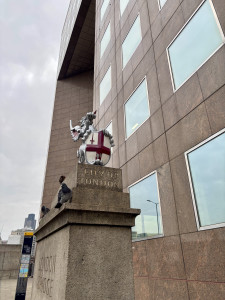
More photos and more about the history of London sewers and public loos under the cut (sometimes out of chronological order, as we passed by various structures)..
( Read more... )
It was a very interesting walk, and we really enjoyed it. We were home by mid-afternoon and were surprised to find we'd walked nearly 10 miles (16km) as we'd walked to the station as well as the meeting and ending places of the walk! We will look out for more walks by Walking Post as it was fun.
It was another dull day, but not cold (15ºC/59ºF) and dry, which was perfect for the five-and-three-quarter-mile (9km) walk. We travelled to London Bridge and walked across the river to Tower Hill to meet up with the group, entering the City of London on the way as marked by the dragon on London Bridge:

More photos and more about the history of London sewers and public loos under the cut (sometimes out of chronological order, as we passed by various structures)..
( Read more... )
It was a very interesting walk, and we really enjoyed it. We were home by mid-afternoon and were surprised to find we'd walked nearly 10 miles (16km) as we'd walked to the station as well as the meeting and ending places of the walk! We will look out for more walks by Walking Post as it was fun.

The walk was primarily to highlight the ties to black history in London, but we looked at much more than that as we walked around the tiny alleyways in the City. We ended up at the Guildhall Art Gallery to see a couple of their paintings at the end of the two-hour walk. More under the cut with photos of things that I found interesting.
( Read more... )
It was a thought-provoking walking tour and one I've been thinking about a lot since I got back home.
A London trip to see dotty pictures...
Oct. 8th, 2025 09:57 amYesterday I went to the National Gallery in London to see their exhibition Radical Harmony: Helene Kröller-Müller's Neo-Impressionists. Georges Seurat began a whole movement of painting by using small dots to create paintings back in the early 1880s. This style became known as Pointillism, and the movement was named Neo-Impressionism. It was considered radical and different at the time, and many other artists began to copy the style, including Van Gogh, Paul Signac, Anna Boch, Jan Toorop and Henri-Edmond Cross.
The National Gallery has brought together paintings collected by Helene Kröller-Müller (with a few collected by others), who founded the Kröller-Müller Museum in the Netherlands. As one of the foremost women art patrons of the 20th century, her collection of Neo-Impressionism is one of the most extensive in the world. Under the cut are many photos from the exhibition because this style fascinates me, and has been a huge influence on modern art today.
Teaser - one of my favourite paintings (usually displayed in the National Gallery as part of their permanent collection). Théo van Rysselberghe's Coastal Scene (1892) reminds me so much of living on the coast in Bergen, Norway, although this is likely painted in the Mediterranean.

( Read more... )
An interesting art movement and some lovely examples. The exhibition is on until February 2026.
The National Gallery has brought together paintings collected by Helene Kröller-Müller (with a few collected by others), who founded the Kröller-Müller Museum in the Netherlands. As one of the foremost women art patrons of the 20th century, her collection of Neo-Impressionism is one of the most extensive in the world. Under the cut are many photos from the exhibition because this style fascinates me, and has been a huge influence on modern art today.
Teaser - one of my favourite paintings (usually displayed in the National Gallery as part of their permanent collection). Théo van Rysselberghe's Coastal Scene (1892) reminds me so much of living on the coast in Bergen, Norway, although this is likely painted in the Mediterranean.

( Read more... )
An interesting art movement and some lovely examples. The exhibition is on until February 2026.
Another outing to Leighton House
Sep. 21st, 2025 09:06 amOn Friday, I met a friend and we visited the Leighton House Museum (the history of which you can read about here). I've been there many times, but my friend had never seen it, so it was nice to show her around and see the temporary exhibition: Victorian Treasures from Cecil French and Scott Thomas Buckle, which was about to close.
I love Leighton House - it has amazing interiors and was clearly a beloved home to Frederic, Lord Leighton, who extended and added to it over time. It was built in 1865 when Leighton was 35 years old and already an extremely accomplished and popular artist, and was designed to be the perfect house for an artist with an enormous studio. It was also a place where Leighton could display various objects he acquired on his many travels abroad, including my favourite space in the house - the Arab Hall - decorated with tiles, and with a wonderful fountain in the centre. It is so tranquil...

However, we were there to see the Victorian drawings and paintings in the collections of Cecil French and Scott Thomas Bucle, and under the cut are some examples, including a few things from the house (just because). Picture heavy (they enlarge with a click).
( Read more... )
It was good to catch the exhibition before it ended and my friend really enjoyed visiting Leighton House and is determined to visit again.
I love Leighton House - it has amazing interiors and was clearly a beloved home to Frederic, Lord Leighton, who extended and added to it over time. It was built in 1865 when Leighton was 35 years old and already an extremely accomplished and popular artist, and was designed to be the perfect house for an artist with an enormous studio. It was also a place where Leighton could display various objects he acquired on his many travels abroad, including my favourite space in the house - the Arab Hall - decorated with tiles, and with a wonderful fountain in the centre. It is so tranquil...

However, we were there to see the Victorian drawings and paintings in the collections of Cecil French and Scott Thomas Bucle, and under the cut are some examples, including a few things from the house (just because). Picture heavy (they enlarge with a click).
( Read more... )
It was good to catch the exhibition before it ended and my friend really enjoyed visiting Leighton House and is determined to visit again.
(no subject)
Sep. 10th, 2025 06:30 pmToday, Mr Cee took the day off, and we drove to West Horsley Place for another of their tours around this fascinating building. The first time we visited, back in March, we took the Film tour (previous entry here). I took some similar photos this time, but we did see an additional room, and we also learned more about the fixtures and fittings (including some artwork), so this could be considered West Horsley Place, part two *g*
Our journey was severely delayed because of a 'police incident' on the slip road to Gatwick Airport, which caused huge tailbacks and traffic jams. We also ended up driving through bands of torrential rain, which also slowed the traffic down. The journey should only have taken around an hour, but ended up being nearer to two hours, so we arrived late. Fortunately, we could call ahead and warn them, and so we joined the tour 20 minutes late and only missed the general introduction (which we'd heard on the last visit).
We joined the tour in The Morning Room. The floor is original, and the many windows flood the room with light, allowing this to be used as a room for the ladies of the house to sit and read or do embroidery and other ladylike pursuits back in the 1700s.

More architectural detail under the cut, and the story about what happened to Sir Walter Raleigh's head and possibly the way his widow carried it around with her for many years after his death (including a photo of the bag)...!
( Read more... )
We stopped off at a very nice local pub for lunch, and managed to avoid all the issues on the roads on the way home by avoiding the main motorways. We got back after an hour, which was fine!
Our journey was severely delayed because of a 'police incident' on the slip road to Gatwick Airport, which caused huge tailbacks and traffic jams. We also ended up driving through bands of torrential rain, which also slowed the traffic down. The journey should only have taken around an hour, but ended up being nearer to two hours, so we arrived late. Fortunately, we could call ahead and warn them, and so we joined the tour 20 minutes late and only missed the general introduction (which we'd heard on the last visit).
We joined the tour in The Morning Room. The floor is original, and the many windows flood the room with light, allowing this to be used as a room for the ladies of the house to sit and read or do embroidery and other ladylike pursuits back in the 1700s.

More architectural detail under the cut, and the story about what happened to Sir Walter Raleigh's head and possibly the way his widow carried it around with her for many years after his death (including a photo of the bag)...!
( Read more... )
We stopped off at a very nice local pub for lunch, and managed to avoid all the issues on the roads on the way home by avoiding the main motorways. We got back after an hour, which was fine!
A visit to the London Garden Museum
Sep. 9th, 2025 07:27 pmToday I met up with seven other members of our local U3A group for a trip to The Garden Museum. Despite the tube trains being on strike, we managed to get there very easily by train and bus. The museum is housed in a deconsecrated church, located next to Lambeth Palace, with a cool sign outside.

They were changing the main display in the Museum, but despite this, there were lots of things to see, including Cecil Beaton's Garden Party exhibition. Cecil Beaton was famous for his dress designs, but he was also a very keen gardener and used flowers in many of the photographs of his clients dressed in his creations. There were also lots of items connected to gardening, garden designers and gardeners. Lots of photos under the cut (as usual!).
( Read more... )
I'm glad I went on the outing as I've been past the museum several times, but never actually gone in. It will be worth revisiting once they have finished the renovations.

They were changing the main display in the Museum, but despite this, there were lots of things to see, including Cecil Beaton's Garden Party exhibition. Cecil Beaton was famous for his dress designs, but he was also a very keen gardener and used flowers in many of the photographs of his clients dressed in his creations. There were also lots of items connected to gardening, garden designers and gardeners. Lots of photos under the cut (as usual!).
( Read more... )
I'm glad I went on the outing as I've been past the museum several times, but never actually gone in. It will be worth revisiting once they have finished the renovations.
A new take on old artworks...
Aug. 30th, 2025 03:23 pmOn Thursday, I visited The Wallace Collection in London to see their exhibition, Grayson Perry: Delusions of Grandeur.
Sir Grayson Perry is an English artist who has always challenged the 'prejudices, fashions and foibles' of the art world. He works in ceramics, paint, needlework, tapestry and pencil. He identifies as a transvestite, frequently appearing as his alter-ego 'Claire' in public (who also features in his artwork along with childhood teddy bear Alan Measles). Married to a well-known author and psychiatrist (Phillipa Perry), he also looks at the psychology behind art.
For this exhibition, he created a character, Shirley Smith. I love how he explains the concept behind the exhibition here (it's a couple of minutes long, but it gives you a real flavour of what he set out to achieve in the exhibition). Also, I love Sir Grayson Perry - he's bonkers, but he has a very interesting 'take' on art which is always worth listening to.
Under the cut for photos of the artwork from the Wallace Collection, which was displayed alongside the new artwork by both Sir Grayson Perry (and 'Shirley Smith' *wink*).
( Read more... )
A very eclectic selection of items inspired by a whole Collection of things - it was an interesting exhibition and worth visiting.
Sir Grayson Perry is an English artist who has always challenged the 'prejudices, fashions and foibles' of the art world. He works in ceramics, paint, needlework, tapestry and pencil. He identifies as a transvestite, frequently appearing as his alter-ego 'Claire' in public (who also features in his artwork along with childhood teddy bear Alan Measles). Married to a well-known author and psychiatrist (Phillipa Perry), he also looks at the psychology behind art.
For this exhibition, he created a character, Shirley Smith. I love how he explains the concept behind the exhibition here (it's a couple of minutes long, but it gives you a real flavour of what he set out to achieve in the exhibition). Also, I love Sir Grayson Perry - he's bonkers, but he has a very interesting 'take' on art which is always worth listening to.
Under the cut for photos of the artwork from the Wallace Collection, which was displayed alongside the new artwork by both Sir Grayson Perry (and 'Shirley Smith' *wink*).
( Read more... )
A very eclectic selection of items inspired by a whole Collection of things - it was an interesting exhibition and worth visiting.
Diamonds are a girl's best friend....
Aug. 16th, 2025 03:09 pmOn Friday, Mr Cee took the day off, and we headed to the V&A in London to see their Cartier Exhibition. The exhibition has been sold out for weeks (and it doesn't finish until November!), but as I have a Membership card (for me plus a guest), we could just walk in to see it without booking (the Membership is really worth it!).
This is how the curators Helen Molesworth and Rachel Garrahan describe the exhibition:
"Cartier is one of the most famous jewellery houses in the world. This exhibition explores how Louis, Pierre and Jacques Cartier, together with their father Alfred, adopted a strategy of original design, exceptional craftsmanship and international expansion that transformed the Parisian family jeweller into a household name."
Established in 1847 by Louis-François Cartier, the business expanded once his grandsons joined the firm, and by 1909 they had expanded their branches to Paris, London and New York.
It's a large exhibition (more than 350 items of jewellery, clocks and watches) and they have divided it into sections covering the influences in design, and custom works for patrons of Cartier, the jewellers. Under the cut for lots of sparkly things that caught my eye (there are quite a few)!
( Read more... )
We spent a couple of hours at the exhibition, and I'm tempted to go back again as it's a bit overwhelming to see so much bling!
This is how the curators Helen Molesworth and Rachel Garrahan describe the exhibition:
"Cartier is one of the most famous jewellery houses in the world. This exhibition explores how Louis, Pierre and Jacques Cartier, together with their father Alfred, adopted a strategy of original design, exceptional craftsmanship and international expansion that transformed the Parisian family jeweller into a household name."
Established in 1847 by Louis-François Cartier, the business expanded once his grandsons joined the firm, and by 1909 they had expanded their branches to Paris, London and New York.
It's a large exhibition (more than 350 items of jewellery, clocks and watches) and they have divided it into sections covering the influences in design, and custom works for patrons of Cartier, the jewellers. Under the cut for lots of sparkly things that caught my eye (there are quite a few)!
( Read more... )
We spent a couple of hours at the exhibition, and I'm tempted to go back again as it's a bit overwhelming to see so much bling!
An outing to see an assortment of homes
Aug. 15th, 2025 04:49 pmYesterday I braved the 30º/86ºF heat in London to meet up with Youngest Cee's fiancée's mum, L in Hoxton in East London. We went to The Museum of the Home (formerly known as The Geffrye Museum). The museum is situated in a 18th-century former almshouses built on the site in 1714. They were built at the bequest of Sir Robert Geffrye to house the widows of ironmongers - up to 56 pensioners were given homes in the almshouses and had access to a chapel and a garden.
Sir Robert Geffrye was a merchant and trader in tobacco, which means he had part ownership of a slave ship, and his fortune was largely built on the Atlantic slave trade. Rather than remove all references to him, the museum has explained his history very sensitively for today's visitors without trivialising the links. He has no connection to the museum, only to the former almshouses.
I have visited the museum a couple of times before, but in 2018, they closed it completely to refurbish it, so I was interested to see how different it was. I was pleasantly surprised as they have looked more deeply into the meaning of 'home' and how different aspects change how we decorate and furnish our living spaces.
The exterior of the former almshouses is still very impressive (not my photo):

Some more photos under this cut:
( Read more... )
We found a very nice place to have a healthy lunch (and a glass of wine!) and spent a couple of hours chatting about all kinds of things, which was lovely!. It was a good outing.
Sir Robert Geffrye was a merchant and trader in tobacco, which means he had part ownership of a slave ship, and his fortune was largely built on the Atlantic slave trade. Rather than remove all references to him, the museum has explained his history very sensitively for today's visitors without trivialising the links. He has no connection to the museum, only to the former almshouses.
I have visited the museum a couple of times before, but in 2018, they closed it completely to refurbish it, so I was interested to see how different it was. I was pleasantly surprised as they have looked more deeply into the meaning of 'home' and how different aspects change how we decorate and furnish our living spaces.
The exterior of the former almshouses is still very impressive (not my photo):

Some more photos under this cut:
( Read more... )
We found a very nice place to have a healthy lunch (and a glass of wine!) and spent a couple of hours chatting about all kinds of things, which was lovely!. It was a good outing.
Yesterday I went to London to meet up with the National U3A group for a guided historic walk around the Kensington and Chelsea area. We began our walk at the Victoria and Albert Museum's imposing entrance.

The V&A was created after the 1851 Great Exhibition, when it was decided that a permanent site for collections should be created, and in 1852, Marlborough House was opened as the first public museum site called the South Kensington Museum. It was the first museum to have a café so that researchers could dine.
The current site was originally the home of the Brompton Park Nursery, growing produce for the city. In 1899, Queen Victoria laid the foundation stone for the current building (although she did not live long enough to see it completed nine years later), and the building was renamed the Victoria and Albert Museum.
More under the cut with photos of the area - including statues, churches, stables and architectural features.
( Read more... )
The two-hour walk took us around in a loop of the V&A and was very interesting. Many of the areas I'd not walked around before, and I shall definitely be exploring again another day.

The V&A was created after the 1851 Great Exhibition, when it was decided that a permanent site for collections should be created, and in 1852, Marlborough House was opened as the first public museum site called the South Kensington Museum. It was the first museum to have a café so that researchers could dine.
The current site was originally the home of the Brompton Park Nursery, growing produce for the city. In 1899, Queen Victoria laid the foundation stone for the current building (although she did not live long enough to see it completed nine years later), and the building was renamed the Victoria and Albert Museum.
More under the cut with photos of the area - including statues, churches, stables and architectural features.
( Read more... )
The two-hour walk took us around in a loop of the V&A and was very interesting. Many of the areas I'd not walked around before, and I shall definitely be exploring again another day.
A Medieval visit to London
Jul. 4th, 2025 10:01 amYesterday, a friend and I went to visit The Charterhouse in London. I've been several times, but she'd never been, so it was fun to go back again.

The Charterhouse's history goes back to 1348 when the site was used as an emergency cemetery for plague victims in London. The 'Black Death' killed 60% of the London population, and a Chapel was built on the site for mourners to pray for the victims' souls. Following this, a Carthusian monastery (known as a Charterhouse) was built nearby in 1371 and thrived for many years.
In 1545, following the dissolution of the monasteries by Henry VIII (which led to the death of the monks and the seizing of the land by the Crown), a Tudor manor house was built using some parts of the old monastery. You can just see some of the original stones above the bench in the frieze at the base of the building if you click the photo.
In 1611, Thomas Sutton, a wealthy landowner, bought the site and turned it into a charitable institution which included a school for 'poor' boys and almshouse accommodation for 80 impoverished 'poor Brothers'. Today, the school has relocated, but it is still home to 43 people who are given free accommodation if they meet certain criteria. This is still fully funded by the charity Sutton set up and is maintained by Governors (including King Charles II).
More under the cut with photos.
( Read more... )
The criteria for becoming a Brother at The Charterhouse in 1611 - you would have to be “either decrepit or old captaynes either at sea or at land, maimed or disabled soldiers, merchants fallen on hard times, those ruined by shipwreck or other calamity”. It was originally a Faith-based charity.
Today the criteria are: you must be single, and over 60 years old; in financial, housing or social need and have no significant debts. You must be able to live independently, be keen to contribute to a community and have the right to live in the UK.
I'd love to live there, but there are a couple of criteria I don't meet! LOL!
It was a fascinating tour, and even though I've been before, I learned some new things, which is always good!

The Charterhouse's history goes back to 1348 when the site was used as an emergency cemetery for plague victims in London. The 'Black Death' killed 60% of the London population, and a Chapel was built on the site for mourners to pray for the victims' souls. Following this, a Carthusian monastery (known as a Charterhouse) was built nearby in 1371 and thrived for many years.
In 1545, following the dissolution of the monasteries by Henry VIII (which led to the death of the monks and the seizing of the land by the Crown), a Tudor manor house was built using some parts of the old monastery. You can just see some of the original stones above the bench in the frieze at the base of the building if you click the photo.
In 1611, Thomas Sutton, a wealthy landowner, bought the site and turned it into a charitable institution which included a school for 'poor' boys and almshouse accommodation for 80 impoverished 'poor Brothers'. Today, the school has relocated, but it is still home to 43 people who are given free accommodation if they meet certain criteria. This is still fully funded by the charity Sutton set up and is maintained by Governors (including King Charles II).
More under the cut with photos.
( Read more... )
The criteria for becoming a Brother at The Charterhouse in 1611 - you would have to be “either decrepit or old captaynes either at sea or at land, maimed or disabled soldiers, merchants fallen on hard times, those ruined by shipwreck or other calamity”. It was originally a Faith-based charity.
Today the criteria are: you must be single, and over 60 years old; in financial, housing or social need and have no significant debts. You must be able to live independently, be keen to contribute to a community and have the right to live in the UK.
I'd love to live there, but there are a couple of criteria I don't meet! LOL!
It was a fascinating tour, and even though I've been before, I learned some new things, which is always good!
Hiroshiga Exhibition
Jun. 14th, 2025 03:49 pmYesterday, we went to the British Museum to see the Hiroshige: Artist of the Open Road exhibition, which was spectacular. It was a warm day (29C/84F) in London, but not an unpleasant walk from Charing Cross station to the museum as we could keep in the shade.
Utagawa Hiroshige (1797–1858) was a very prolific artist and the exhibition contains examples of his landscapes, natural world studies, and studies of all walks of life in Japanese society at the time. A memorial portrait by Utagawa Kunisada.

Hiroshige was orphaned at age 12 and inherited his father's title of fire warden. A superior in the fire department taught him to paint in the Kano school style. By the 1830s he was focusing on his best-known subjects, tranquil views of famous places, city life and the natural world. Living during the Edo period when there was urban growth, but also famine, social crisis and foreign military incursions, HIroshiga concentrated on the positive side of life at the time.
There were a LOT of examples of his work (it's a large exhibition) and so there are many photos under this cut as I adored far too many not to share.
( Read more... )
It was a fascinating exhibition and we enjoyed it very much.
Utagawa Hiroshige (1797–1858) was a very prolific artist and the exhibition contains examples of his landscapes, natural world studies, and studies of all walks of life in Japanese society at the time. A memorial portrait by Utagawa Kunisada.

Hiroshige was orphaned at age 12 and inherited his father's title of fire warden. A superior in the fire department taught him to paint in the Kano school style. By the 1830s he was focusing on his best-known subjects, tranquil views of famous places, city life and the natural world. Living during the Edo period when there was urban growth, but also famine, social crisis and foreign military incursions, HIroshiga concentrated on the positive side of life at the time.
There were a LOT of examples of his work (it's a large exhibition) and so there are many photos under this cut as I adored far too many not to share.
( Read more... )
It was a fascinating exhibition and we enjoyed it very much.
A warm walk around the Kings Cross area
May. 31st, 2025 05:34 pmToday Mr Cee and I went to London to join a guided tour around Kings Cross station. It was hot in London today (26C/79F), slightly humid and sunny. However, our guide found shade each time we stopped during the two-hour walk. He was also very knowledgeable, so it was an interesting walk, and we learned some new things!
We started the walk outside the wonderful St Pancreas Renaissance Hotel. Some may recognise it from Harry Potter and the Chamber of Secrets where it stood in for the less photogenic forecourt of Kings Cross Station:

More photos and some history under the cut.
( Read more... )
It was a fascinating tour, and very interesting (I love it when I learn something new about an area I know well!). We jumped on a train home and were very pleased to sit in the cool at home after quite a warm 4.5 mile/7.2km walk!
We started the walk outside the wonderful St Pancreas Renaissance Hotel. Some may recognise it from Harry Potter and the Chamber of Secrets where it stood in for the less photogenic forecourt of Kings Cross Station:

More photos and some history under the cut.
( Read more... )
It was a fascinating tour, and very interesting (I love it when I learn something new about an area I know well!). We jumped on a train home and were very pleased to sit in the cool at home after quite a warm 4.5 mile/7.2km walk!
A visit with added poison!
May. 30th, 2025 02:11 pmYesterday caught the train to London to meet up with my local U3A (University of the Third Age) 'London Explorers' group at Charing Cross. Twenty-three people turned up (a few who I had met before which was nice!), and we set off on the Bakerloo tube to Regents Park and from there to the Royal College of Physicians.
The Brutalist architecture of the building (designed by Denys Lasdun who also designed the National Theatre on the South Bank) is a stark contrast to the surrounding Regency buildings designed by John Nash (this is not my photo as it was too difficult to get a clear view).

We had a guided tour of the exhibits inside, followed by a tour of their poison garden which was fascinating. Under the cuts for many photos.
Firstly, the inside of the building with a tiny bit of history (apothecary jars, bloodletting, medical instruments and more!)
( Read more... )
After a break for refreshments, we went outside for the one-hour guided tour around the gardens. Our guide was a retired Paediatric Dermatologist and was very knowledgeable about the uses of medicinal plants and the history of the gardens, as he has written books about them!
( Read more... )
It was a very informative visit, and even though I've been a couple of times before I always learn something new from the volunteer guides around the garden. If you're interested in the collections at the Royal College of Physicans you can access their catalogues here, and they offer guided tours throughout the year.
The Brutalist architecture of the building (designed by Denys Lasdun who also designed the National Theatre on the South Bank) is a stark contrast to the surrounding Regency buildings designed by John Nash (this is not my photo as it was too difficult to get a clear view).

We had a guided tour of the exhibits inside, followed by a tour of their poison garden which was fascinating. Under the cuts for many photos.
Firstly, the inside of the building with a tiny bit of history (apothecary jars, bloodletting, medical instruments and more!)
( Read more... )
After a break for refreshments, we went outside for the one-hour guided tour around the gardens. Our guide was a retired Paediatric Dermatologist and was very knowledgeable about the uses of medicinal plants and the history of the gardens, as he has written books about them!
( Read more... )
It was a very informative visit, and even though I've been a couple of times before I always learn something new from the volunteer guides around the garden. If you're interested in the collections at the Royal College of Physicans you can access their catalogues here, and they offer guided tours throughout the year.
A very brief trip away...
May. 17th, 2025 05:01 pmAs we can't plan long trips away at the moment we've been doing the odd day trip, and last week we decided to go to the Warner Brothers Studio Tour "The Making of Harry Potter" again. We first visited back in 2023 when the Harry Potter sets were dressed for Christmas and this time they have dressed the sets to celebrate the Triwizard Tournament.
We decided to stay overnight on Thursday and go to the tour on Friday as that meant we didn't have to rush. So Thursday afternoon we took the train to Watford Junction and stayed in a reasonably priced hotel overnight. It was nice to be away from home, and the hotel was very comfortable (with bonus delicious food for dinner!). After an enormous breakfast on Friday, we walked to the station where they run a free shuttle bus to the Leavesden studios and we got there as it opened.
The studios are HUGE, and there are props, original sets and costumes alongside explanations of how things were made throughout the eight films. We spent four hours there before catching the train home again.
One of the first displays has the Triwizard Cup from Harry Potter and the Goblet of Fire along with the costumes worn by the four champions:

Under the cut for many Harry Potter photos... feel free to skip if you aren't interested!
( Read more... )
We will probably go back at some point as they frequently change the displays. We caught the train home and it only took an hour which was good (and it was free for us).
We decided to stay overnight on Thursday and go to the tour on Friday as that meant we didn't have to rush. So Thursday afternoon we took the train to Watford Junction and stayed in a reasonably priced hotel overnight. It was nice to be away from home, and the hotel was very comfortable (with bonus delicious food for dinner!). After an enormous breakfast on Friday, we walked to the station where they run a free shuttle bus to the Leavesden studios and we got there as it opened.
The studios are HUGE, and there are props, original sets and costumes alongside explanations of how things were made throughout the eight films. We spent four hours there before catching the train home again.
One of the first displays has the Triwizard Cup from Harry Potter and the Goblet of Fire along with the costumes worn by the four champions:

Under the cut for many Harry Potter photos... feel free to skip if you aren't interested!
( Read more... )
We will probably go back at some point as they frequently change the displays. We caught the train home and it only took an hour which was good (and it was free for us).
Yesterday's walk around London was fun. There were eleven of us in the group and the weather behaved itself (although the wind was cold, there was sunshine). Guy, our leader took us on a route which included the Inns of Court and other things both familiar and new including statues, a couple of churches, Templar knights and ancient gates.
I was meeting everyone at Temple Station, so I walked through the Victorian Embankment gardens on the way and stopped to admire this monument for Arthur Sullivan (of Gilbert and Sullivan fame) which is one of my favourite statues. More under the cut.

( Read more... )
It was a good walk and we ended up in a very small pub for lunch before saying our goodbyes. Guy refused to allow us to pay for the walking tour as he said he enjoyed our company. He has promised to schedule another walk in the summer which I'm already looking forward to!
I was meeting everyone at Temple Station, so I walked through the Victorian Embankment gardens on the way and stopped to admire this monument for Arthur Sullivan (of Gilbert and Sullivan fame) which is one of my favourite statues. More under the cut.

( Read more... )
It was a good walk and we ended up in a very small pub for lunch before saying our goodbyes. Guy refused to allow us to pay for the walking tour as he said he enjoyed our company. He has promised to schedule another walk in the summer which I'm already looking forward to!
Two exhibitions on one day!
May. 7th, 2025 08:00 amI went to London today to catch up with two exhibitions at the National Gallery - the weather was cold (15C/59F and windy).
The first exhibition was José María Velasco: A View of Mexico which highlights his lovely landscapes of Mexico. Velasco was born in 1840 (and died in 1912) and this is the first exhibition about a Latin American artist to be held at the National Gallery. There were some lovely landscapes showing the area around the Valley of Mexico (where Mexico City now stands) in the last 19th century.
Some things that caught my eye under the cut - I particularly like how detailed all the paintings are (in some it would appear he used binoculars to see the detail in the distance), and his use of light.
( Read more... )
After a break for coffee and some sustenance, I went to see Siena: The Rise of Painting, 1300 ‒1350. The exhibition was large and was incredibly full of people (so it was hot in there!). I ended up seeing most of it briefly, but I think I shall try and go back to examine some of it again when it's less crowded. Under the cut for photos the exhibits that I thought were really interesting despite not being in the exhibition for very long.
( Read more... )
It was good to fit most of the two exhibitions in. I shall return at another time.
The first exhibition was José María Velasco: A View of Mexico which highlights his lovely landscapes of Mexico. Velasco was born in 1840 (and died in 1912) and this is the first exhibition about a Latin American artist to be held at the National Gallery. There were some lovely landscapes showing the area around the Valley of Mexico (where Mexico City now stands) in the last 19th century.
Some things that caught my eye under the cut - I particularly like how detailed all the paintings are (in some it would appear he used binoculars to see the detail in the distance), and his use of light.
( Read more... )
After a break for coffee and some sustenance, I went to see Siena: The Rise of Painting, 1300 ‒1350. The exhibition was large and was incredibly full of people (so it was hot in there!). I ended up seeing most of it briefly, but I think I shall try and go back to examine some of it again when it's less crowded. Under the cut for photos the exhibits that I thought were really interesting despite not being in the exhibition for very long.
( Read more... )
It was good to fit most of the two exhibitions in. I shall return at another time.


