

I remember with pleasure how some 15 years ago a hunt for a big bull elephant was rewarded with a grand trophy shot in the most dramatic conditions, in the classic style.
A young, active American brought his bride on safari with me, and his principal interest for the first month was filming elephant, a photographic sport which is hard to beat. The best of it is done on foot, and there is always the tingling element of risk. All the photography was, by choice, to be done in hunting country – as opposed to parks – because my client had a shooting licence and hoped to collect a real trophy tusker.
We looked over, and photographed, hundreds of elephants. We saw some reasonably representative ones, but no bull with the almost mythical 100 lb (45 kg) or more of ivory each side.
With the hunting urge still strong after spending a lot of time on photographing, we moved camp to the big-tusk country – the dense bushland near the Indian Ocean coastline.
We hunted there long and hard. The roads were rough, and frequently we bogged when promising tracks were lost after being washed out by the quick, torrential morning showers which swept in from the sea. It was the hot and humid time – but the certain knowledge that we were hunting country which had previously yielded huge tusks was all the spur needed to keep us happy.
One day we left camp as usual at dawn, only this time we proposed to scout thick forest by some sand-dunes to the east. It was necessary to cross several tidal creeks over treacherous mud between mangrove swamps, and at the first bad spot we bogged. Our hunt looked ruined.
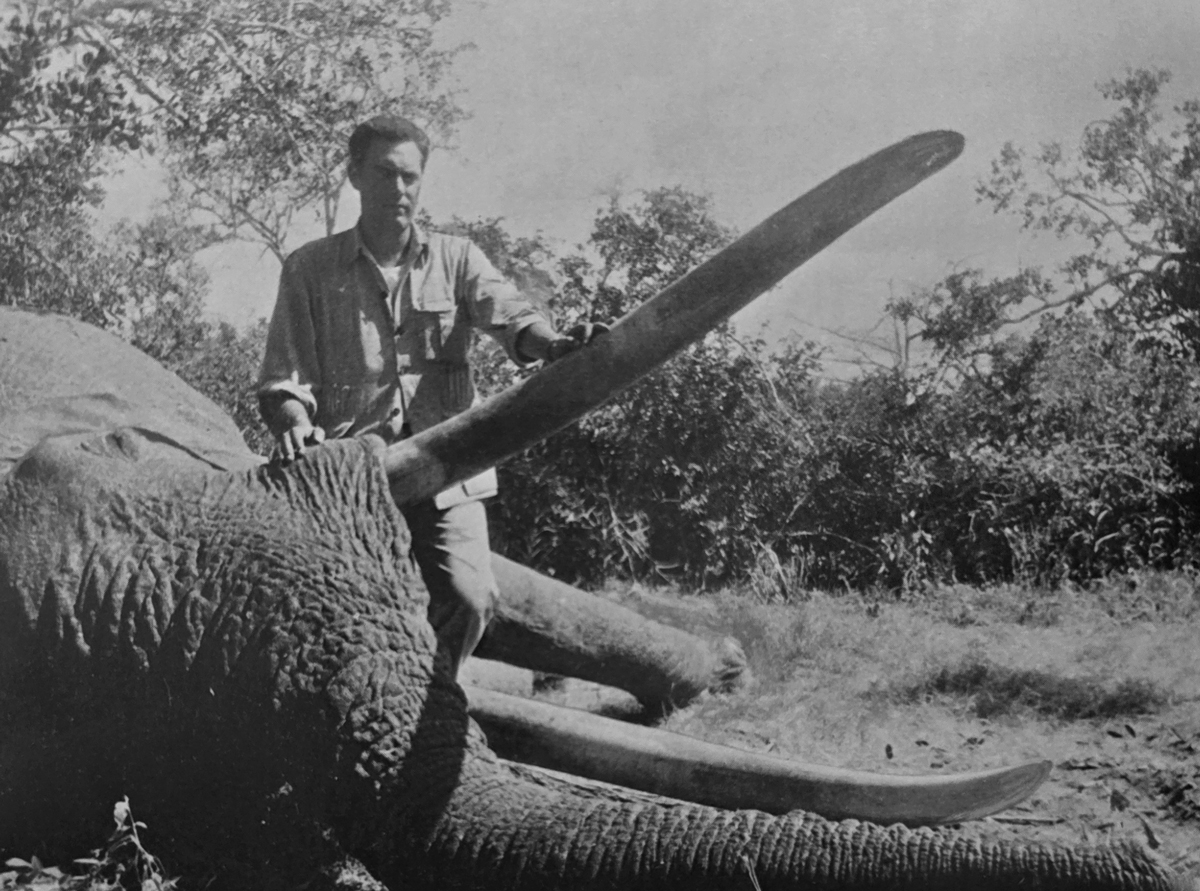
The elephant which charged from thick bush. The record-class tusks weigh 114 lbs and 112 1/2 lbs.
For two hours we jacked the car and made a corduroy road of branches. Just when our plight looked hopeless a “miracle” happened.
We heard the sound of an approaching motor. It was my truck. My men had seen a big bull a few kilometres away on the other side of camp, and had hurried to track us down and give us the good news. A long cable tied to our stern, a good pull, and the sucking black mud yielded up its victim with an agonising squelch of protest.
Off we went again, full of hope. Although I believe second-hand information is almost always exaggerated, I knew my boys and I felt that the combination of circumstances – bogged, delayed, rescued – all justified our optimism. In common with many other hunters we were both optimistic and superstitious.
Soon we were looking at the spoor of three obviously big bull elephants. The footprints were large and fresh. Nearby we found soft droppings, pointing out clearly the animals hadn’t left in a hurry after being badly frightened by the truck. These piles of sign were very large. In Africa we have a saying which is often true: Big droppings, big tusks.
All of that, plus the direction the small mob took in relation to the prevailing wind, and the hour, gave me good cause to hope that the day might still prove a fruitful one.
Time moves quickly when one is intensely excited, and in what seemed a very short while indeed, we had actually tracked the bulls so close we could hear them feeding, listen to the giant rumbling of their stomachs. When I say we had tracked the bulls I meant, of course, that my three Liangulu trackers – the aristocracy of the elephant hunters, and the oldest – had brought us into an excellent position. My boss-tracker, a marvellous old fellow named Mwakati, heard the bulls feeding long before we humble whites knew they were anywhere nearby.
We left the tracks and circled around to approach the quarry cautiously directly into the wind, homing in by sound alone.
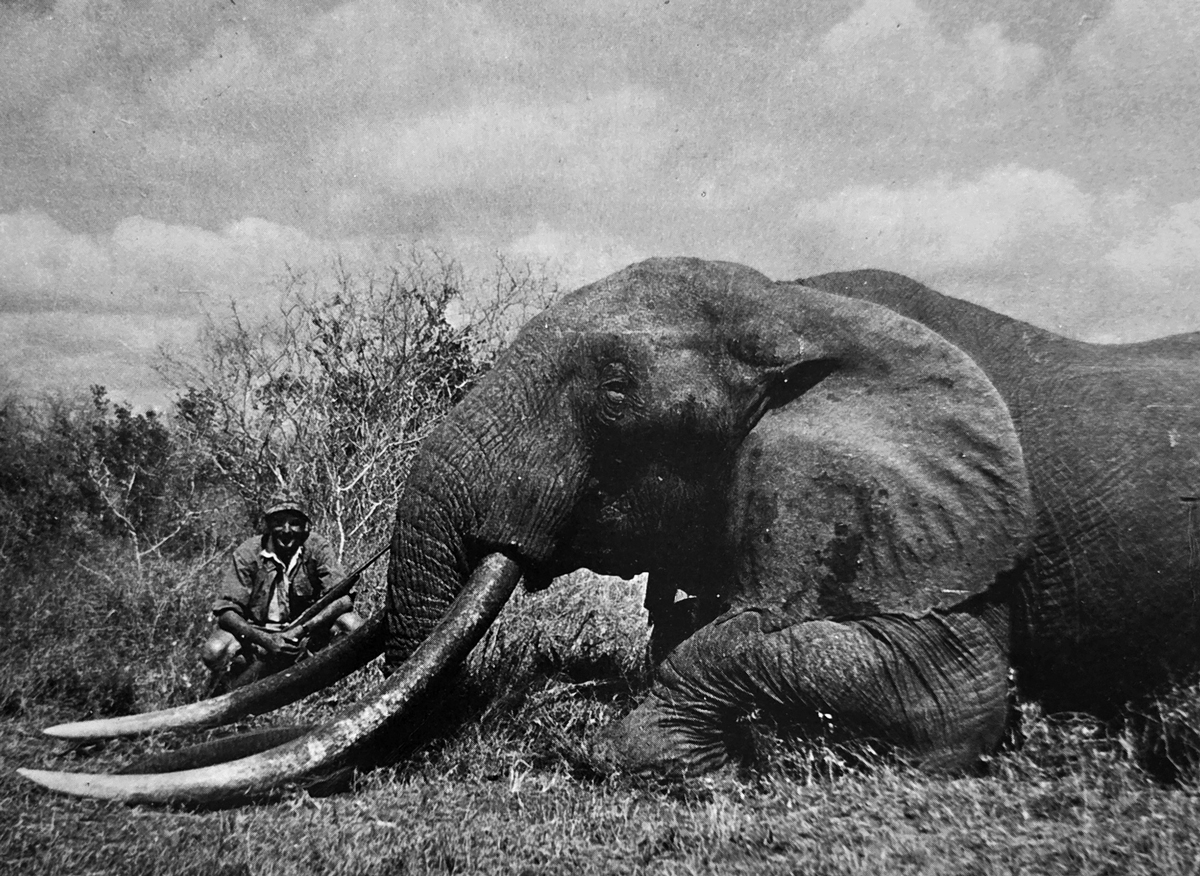
Tony Dyer posing with a rogue which tried to kill him. The tusks are 121 lbs and 119 lbs.
This was the critical time. We were approaching three spread-out, moving beasts, and if we once got up-wind of them we were in trouble. We had to look over all three animals before deciding upon the trophy, and if one but smelled us they would disappear like huge grey ghosts. If that happened the chances were the brutes would start their everlasting migration walk and keep going, outpacing mortal hunters within minutes.
It was the time when the distilled skills of Mwakati, that white-haired gentleman of the jungle, were most evident. The experience of 40 years of poaching big ivory, with maybe 400 elephants to his bow and poisoned arrows, lay behind every move. He moved fast, silently, without hesitation, and with a deadly concentration that exuded confidence, something we “lesser” folk needed to ease our jitters.
Closer we came, yet we had still not seen the three bulls, and for the last few minutes they had been quiet – always a bad sign. Suddenly, from up front, Mwakati dodged away – and now the responsibility for an instant decision was mine.
A patch of mud-caked hide moving through the impossibly thick bush eight metres away. Visibility 10 paces to nothing. Should we shoot?
I was turning… peering… down to ground level and back on tip-toes… desperately trying to glimpse his tusks. The bull moved forward a couple of metres – speedily and with signs of suspicion.
One very big tusk hove momentarily into view; but the other remained elusive. Just then his enormous head shot up and appeared to look down on us. Was he going to charge?
His other tusk was also a beauty. I whispered: “Shoot him,” to my client and almost before the words were out the gun went off.
The shot had been at the heart, as my friend had not been in as advantageous a position as I. The bull backed up and crashed off into the bush – away from us, in panic. He was mortally wounded. I was off after him as fast as the bush allowed.
Within seconds I caught a sight of the bull’s heaving back way above the scrub in front. I fired a shot for the spine, missed it, and succeeded only in spurring the great brute to a faster clip. The urge to get this elephant was foremost in my thoughts when it left me far behind.
Suddenly I was afraid. A wounded tusker in thick bush is not the most exciting prospect with which to contend. The trackers caught up to me, and ran ahead on the hot trail like a pack of eager coursing hounds.
The three bulls had split up, the wounded one going off on its own.
There was only a tiny amount of blood at first, seen high on the leaves. Then, no more blood; the tough skin had folded back over the bullet hole, the fat choking off any flow. My natives had invoked their ancient skills; they were following by spoor alone.
The trackers were phenomenal, they go by smell and instinct some of the time. In this tough, stringy bush and on the hard, sandy ground there were few traces of the huge animal’s passage; yet we pursued at little less than 2 km/h. The bull was possibly doing seven. We were determined to stay with him, sleep on his tracks if necessary. I knew he couldn’t go far, for my client’s shot – although certainly not text-book in placement – was definitely in the vitals as evidenced by the initial blood.
That bull would be very sick.
I told my friends to expect to find the bull dead – or see him rise up in front with his ears flapping wide and trunk curled, looking like some ghastly nightmare. All that – plus the inevitable shrill trumpet, and a timber-crashing, short-range charge that could wipe us out, literally, leaving smears for epitaphs!
Secretly I felt sure we would find him dead, for the heart-shot has never let me down. I knew that too many novices lost elephants by trying for the more difficult brain-shot, without the experience it requires. A heart-shot is not kind, and not always quick, but it does a great deal of damage and is reliable; a bull will not suddenly rise from the ground after being stunned and kill you, as has happened to hunters using “brain” shots.
Three hours had passed and with each 30 minutes came a new trouble to plague us – torrential rain. The rain poured down briefly, drowning the sign, washing away the footprints in the softened earth. But Mwakati kept his boys with their heads down and rumps skyward, and somehow they managed to read the almost non-existent tracks. I forced them into a jog, knowing we needed only a little more luck to get that bull.
Three hours since the first shots and the trail was killing us. Slowly, as only an African game-trail could. It was terribly hot, and the humidity made one suck for air in great gasps. We covered about 5 km and my greatest fear was that the bull had maintained his pace. He could be more than 30 km away.
I tried not to think about it, but just stuck to the trail like a hungry hyena.
Thirty minutes later we raced out onto a little glade about 25 metres long by 10. We stopped – something was all awry. Before we could muster our emotions, make sense of the intangible feeling, the bull charged.
He rushed us like a battleship coming out of the mist. The elephant, true to his breed, intent to kill or be killed. The hunters and their creed: Follow to the end, wherever it leads, fight it out – win, draw or lose.
My friend was beside me in a Hash and the great head was almost upon us. The trackers dived sidewards at the last moment, and in that instant the American’s .470 Nitro express boomed twice, the two carefully aimed, deadly shots seemingly having little effect.
In a flash the man changed guns as though driven grouse were coming at him – bang! bang! and the giant tusker turned to pass within two metres of me. I put a bullet where it belonged, in the top of the heart, and he was down like a baobab tree struck by lightning.
It was all over. The bull was ours. The tusks were 117 lb (53 kg) and 114 lb (51 kg), as good as the best I’ve ever seen. My friend and client was a sound sportsman and truly got the trophy he deserved. The hard way.
This story is from the book The Trophy Hunters by Col Allison. Here, in their own words, some of the best known Trophy Hunters of today and yesterday recapture the essence of the chase, a pursuit as old as time.
