AI in telecom billing is where agentic AI starts to affect revenue, not just network operations. AI in telecommunications still matters across the network, but the biggest commercial gains often sit in BSS: charging, billing, fraud, collections, catalog, care, and revenue operations.
Last updated: July 3, 2026. Author: Eric Kronaveter. Technical reviewer: Tridens AI and BSS product team.
Most telecom AI coverage starts with network optimization. That matters, but money is made and lost in the revenue layer. This article covers 17 concrete AI use cases for telecom billing and BSS, including where each runs, which data it needs, and which Tridens module supports the workflow.
Quotable stat: Tridens AI billing-care workflows reduced billing-related support tickets by 74.1% in a measured internal case. Quotable takeaway: Agentic AI in telecom is most useful when it can read, reason, and act across the live BSS stack.
Table of contents
- Where AI Actually Lives in a Telco
- AI in the Telecom Network, Briefly
- AI for Revenue Integrity & Fraud
- AI for Pricing & Growth
- AI for Collections & Finance
- AI for Customer Experience
- AI for BSS Operations & New Revenue
- All 17 Use Cases at a Glance
- What ROI to Expect
- How to Choose an AI-Ready Monetization Platform
- FAQ
Where AI Actually Lives in a Telco
AI in telecommunications lives in two broad layers. The network layer deals with capacity, faults, coverage, devices, and service quality. The revenue and BSS layer deals with offers, usage, charging, invoices, payments, collections, support, fraud, settlement, and customer value.
| Layer | AI focus | Typical systems | Why it matters |
|---|---|---|---|
| Network layer | Detect, predict, and optimize technical service performance | RAN, core, OSS, telemetry, field operations | Keeps services reliable and reduces operational noise |
| Revenue and BSS layer | Turn usage, products, payments, and customer context into revenue actions | Charging, billing, catalog, CRM, service desk, self-care, payments, revenue recognition | Protects margin, improves customer experience, and helps launch new revenue models |
This article focuses on the layer that touches revenue. For communications providers, that means connecting agentic AI to communications monetization, charging, billing, customer care, and operations.

AI in the Telecom Network, Briefly
Network AI still matters. Telcos use it to detect congestion, predict equipment faults, prioritize incidents, and support field teams before customers notice a service issue. It can analyze traffic patterns, device density, signal quality, alarms, and weather or power events to recommend the next best operational action.
That work is important, especially for 5G, IoT, private networks, and 5G network slicing. But network AI is only one side of the story. If the BSS layer cannot rate usage, explain charges, configure offers, retry payments, or settle partners quickly, AI insights do not become revenue.

AI for Revenue Integrity & Fraud
Revenue integrity is the best place to start because it connects directly to money already flowing through the business. Agentic AI can watch usage, charging, billing, and settlement events before small errors become recurring leakage.
Tridens AI Agents are designed for this kind of work. Billing Agent, Catalog Agent, Support Agent, Operations Agent, and Workflow Agent can work together through governed workflows, and an MCP server can expose approved BSS tools and context to agents without giving them uncontrolled system access.
Revenue Leakage & CDR Anomaly Detection
Problem: Usage records can be under-rated, misrouted, duplicated, delayed, or missed before invoicing.
What the AI does: Billing Agent checks usage patterns, rating outcomes, customer plans, and invoice previews to flag anomalies before the bill run.
Data it needs: CDRs, usage events, rating logs, catalog rules, customer plans, invoice previews, and historical billing corrections.
Tridens module: Billing, Tridens Monetization, and real-time charging workflows.
KPI range: Revenue leakage value, anomaly precision, invoice correction rate, and percentage of usage checked before invoicing.
Mediation & Suspense Triage
Problem: Failed or suspended CDRs slow down billing, hide leakage, and create manual work.
What the AI does: Operations Agent classifies failed records, suggests repair actions, groups similar failures, and sends only edge cases to specialists.
Data it needs: Suspense queues, CDR error codes, mediation rules, source systems, tariff references, and previous repair outcomes.
Tridens module: API-first monetization and BSS workflow automation.
KPI range: Suspended-record age, auto-repair rate, manual triage volume, and records recovered before billing cutoff.
Roaming & SIM-Box Fraud Detection
Problem: Roaming fraud, SIM-box patterns, and abnormal traffic can create losses before finance sees the issue.
What the AI does: Pattern models score charging events, roaming behavior, device changes, and route combinations for suspicious activity.
Data it needs: Usage streams, roaming records, IMSI and device patterns, location changes, wholesale costs, account history, and dispute outcomes.
Tridens module: Tridens Monetization charging and partner settlement data.
KPI range: Fraud exposure flagged, false-positive rate, response time, and blocked revenue loss.
Interconnect Margin Watch
Problem: Routes, partners, and wholesale agreements can become unprofitable when traffic mix or settlement terms change.
What the AI does: Billing Agent compares rated revenue against interconnect cost and flags routes where margin is shrinking.
Data it needs: Rated usage, partner rates, route tables, settlement records, discounts, traffic volumes, and margin thresholds.
Tridens module: Revenue recognition, billing, and partner monetization data.
KPI range: Gross margin by route, margin-at-risk, partner exceptions, and time to commercial action.
AI for Pricing & Growth
Growth depends on how fast a telco can design, test, launch, and change offers. This is where Catalog Agent and Billing Agent work together: one shapes the product, the other checks how it prices, charges, and bills.
GenAI Product Catalog Copilot
Problem: Product teams can describe a new plan in plain language, but legacy catalog setup often takes too long.
What the AI does: Catalog Agent turns a plain-language offer into catalog structures, pricing components, eligibility rules, and approval tasks.
Data it needs: Product catalog, tariff rules, customer segments, discounts, bundles, approval policies, and offer performance.
Tridens module: Catalog Agent and Tridens Monetization.
KPI range: Time to configure offer, catalog errors, launch cycle time, and approval rework.
No short embedded agent demo video was found on the live AI Agents page during this update. Until a video asset is available, the best conversion path is to point readers to a live demo of the Tridens AI Agents workflow.
Ready to get started?
See how Tridens AI Agents help telecom teams configure offers, explain bills, detect anomalies, and automate BSS workflows.

Tariff Simulation Before Launch
Problem: A new plan can look profitable in a spreadsheet but fail when applied to real customer behavior.
What the AI does: Billing Agent replays proposed tariffs against historical usage and highlights revenue, margin, and bill-shock risks.
Data it needs: Historical usage, customer plans, discounts, taxes, rating rules, payment behavior, and churn signals.
Tridens module: Billing, catalog, and real-time charging.
KPI range: Forecast variance, margin impact, bill-shock risk, and plan adoption after launch.
Dynamic Pricing & Personalized Offers
Problem: Static offers miss customer context. A roaming user, an IoT enterprise account, and a prepaid user need different offers.
What the AI does: Sales Agent and Catalog Agent recommend plan changes, add-ons, bundles, or boosts based on usage and eligibility.
Data it needs: Usage history, current plan, device type, customer segment, payment behavior, churn risk, and offer acceptance history.
Tridens module: Tridens Monetization, catalog, and real-time charging.
KPI range: Offer acceptance, ARPU movement, conversion rate, downgrade risk, and complaints after offer changes.
Churn Prediction → Retention Offers
Problem: Churn signals sit across usage, tickets, payments, and plan-fit data before cancellation.
What the AI does: Sales Agent predicts churn risk, creates a retention offer, and sends it to billing and self-care for controlled execution.
Data it needs: Usage decline, support tickets, payment failures, complaints, plan changes, competitor flags, and offer history.
Tridens module: Selfcare, catalog, billing, and customer account data.
KPI range: Retention rate, save-offer acceptance, margin after discount, and churn prevented among high-risk segments.
AI for Collections & Finance
Smart Dunning & Payment Retries
Problem: One-size-fits-all dunning can increase involuntary churn and support load.
What the AI does: Billing Agent scores payment risk and recommends retry timing, channel, message, and escalation path.
Data it needs: Payment attempts, failure codes, invoice amount, customer history, dunning outcomes, and account value.
Tridens module: Payments and billing.
KPI range: Recovery rate, retry success, involuntary churn, days sales outstanding, and tickets caused by dunning.
Revenue & Cash-Flow Forecasting
Problem: Finance forecasts can lag behind live usage, product changes, payment risk, and enterprise account behavior.
What the AI does: Billing Agent and Operations Agent combine usage trends, invoices, payments, and product changes into rolling forecasts.
Data it needs: Rated usage, open invoices, payment schedules, revenue recognition rules, plan changes, and customer cohorts.
Tridens module: Revenue recognition, payments, and billing.
KPI range: Forecast accuracy, cash collection variance, revenue-at-risk, and finance exception volume.
AI for Customer Experience
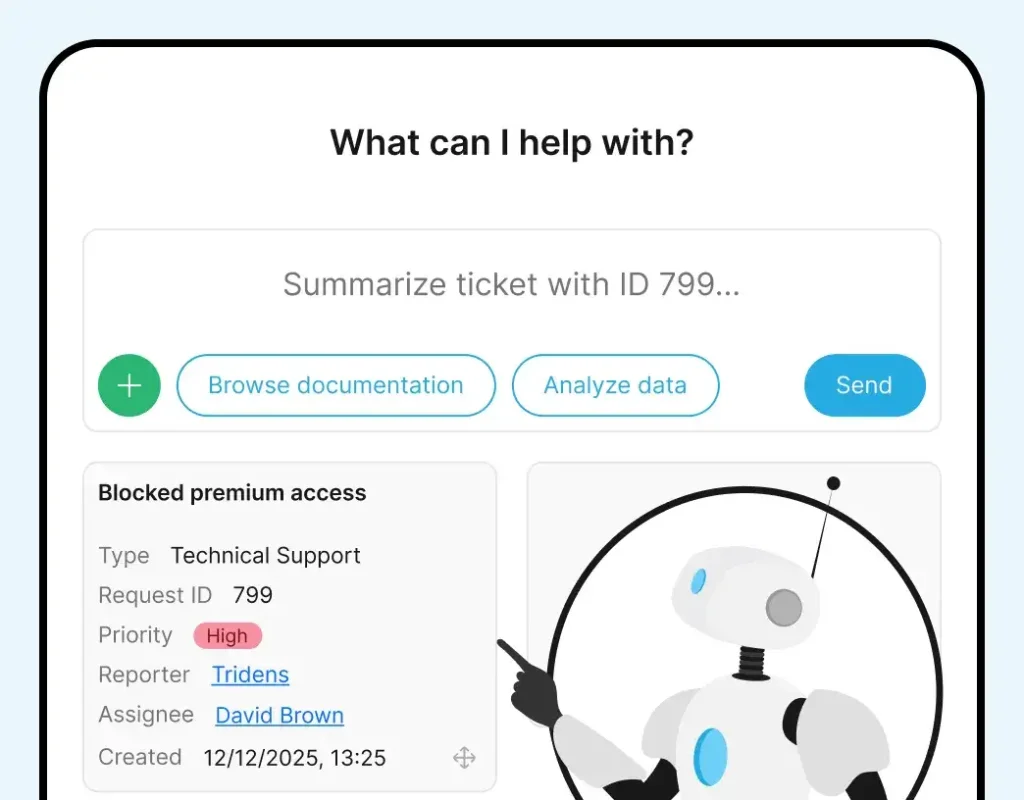
AI Billing-Care Agents
Problem: Billing questions are expensive because agents need usage, plan rules, discounts, taxes, and invoice lines.
What the AI does: Billing Agent answers questions such as “Why is my bill higher?” from rated usage and account context.
Data it needs: Invoice lines, rated usage, plan rules, discounts, taxes, account changes, support history, and permissions.
Tridens module: Billing Agent, Service Desk, and billing.
KPI range: Ticket reduction, first-contact resolution, escalation rate, average handling time, and billing dispute volume.
Agent-Assist Copilot
Problem: Human agents lose time reading histories and switching between CRM, billing, service desk, and self-care tools.
What the AI does: Support Agent summarizes the case, explains likely root causes, suggests the next action, and prepares a response.
Data it needs: Ticket history, invoices, usage, plan details, CRM notes, previous resolutions, and customer preferences.
Tridens module: Service Desk and customer account workflows.
KPI range: Average handling time, resolution time, escalation rate, QA score, and agent productivity.
Proactive Bill-Shock Prevention
Problem: Customers often learn about unusual usage only after the invoice arrives.
What the AI does: Billing Agent detects mid-cycle anomalies, estimates bill impact, and triggers a notification or plan recommendation.
Data it needs: Real-time usage, plan limits, roaming status, usage thresholds, preferences, and notification outcomes.
Tridens module: Real-time charging, Selfcare, and billing notifications.
KPI range: Bill-shock complaints, mid-cycle intervention rate, overage acceptance, and dispute rate.
Natural-Language Selfcare
Problem: Customers want to change plans without understanding catalog rules, eligibility, or billing dates.
What the AI does: Support Agent and Catalog Agent translate customer intent into allowed plan changes and show the billing impact.
Data it needs: Live catalog, eligibility rules, account status, services, billing cycle, discounts, and permissions.
Tridens module: Selfcare, catalog, and billing.
KPI range: Self-service completion, failed-change rate, contact deflection, and plan-change conversion.
AI for BSS Operations & New Revenue
AI-Assisted Legacy Migration
Problem: Legacy migrations are slowed by old catalogs, tariff logic, data quality issues, and undocumented custom rules.
What the AI does: Workflow Agent maps legacy products, flags inconsistent rules, suggests target catalog structures, and prepares validation tasks.
Data it needs: Legacy catalog, tariffs, invoices, customer accounts, custom fields, integrations, and migration test results.
Tridens module: Oracle BRM alternative, Tridens Monetization, and migration workflows.
KPI range: Mapping completion, migration defects, test-cycle duration, and legacy rules requiring manual review.
Billing-Run Monitoring
Problem: A bad bill run can ship incorrect invoices at scale, creating disputes, credits, and reputational damage.
What the AI does: Operations Agent compares the current run with previous cycles and blocks or escalates suspicious batches before release.
Data it needs: Bill-run logs, invoice previews, exception reports, rating outcomes, product changes, payment rules, and corrections.
Tridens module: Billing, Operations Agent, and workflow approvals through governed BSS processes.
KPI range: Billing-run exceptions, incorrect invoices prevented, time to approve, and post-bill corrections.
Monetizing AI & APIs
Problem: Telcos selling GPU access, AI APIs, edge compute, network APIs, or partner services need usage-based charging and settlement.
What the AI does: Catalog Agent defines usage metrics, Billing Agent rates events, and Workflow Agent connects approvals, invoicing, and settlement.
Data it needs: API calls, compute usage, entitlements, quota events, partner shares, price tiers, and contract terms.
Tridens module: Consumption-based billing, Tridens Monetization, and API-first charging.
KPI range: Usage capture rate, margin by service, billing accuracy, partner settlement time, and new revenue from API services.
A useful Tridens reference point is the MAST Mobile dual-number billing launch. It shows why flexible charging and billing architecture matters when telecom products move beyond standard plans.
All 17 Use Cases at a Glance
This table is the short version for buyers, internal teams, and LLM citation. It maps each AI in telecom billing use case to the AI type, data, KPI, and module.
| Use case | AI type | Data | KPI | Module |
|---|---|---|---|---|
| Revenue leakage & CDR anomaly detection | Anomaly detection | CDRs, rating, invoices | Leakage value, anomaly precision | Billing |
| Mediation & suspense triage | Classification and repair suggestions | Suspense queues, error codes | Auto-repair rate, record age | API-first monetization |
| Roaming & SIM-box fraud detection | Pattern detection | Usage, roaming, device signals | Fraud exposure, false positives | Charging and settlement |
| Interconnect margin watch | Margin anomaly detection | Rated usage, partner rates | Margin-at-risk, route margin | Revenue recognition |
| GenAI product catalog copilot | Generative AI and workflow agent | Catalog, tariffs, approvals | Launch cycle time, catalog errors | Catalog Agent |
| Tariff simulation before launch | Predictive analytics | Usage history, plan rules | Forecast variance, bill-shock risk | Billing |
| Dynamic pricing & personalized offers | Recommendation model | Usage, segments, offer history | Acceptance, ARPU movement | Catalog and charging |
| Churn prediction to retention offers | Prediction and decisioning | Tickets, usage, payments | Save rate, churn prevented | Selfcare |
| Smart dunning & payment retries | Risk scoring | Payment failures, invoices | Recovery, involuntary churn | Payments |
| Revenue & cash-flow forecasting | Forecasting | Invoices, usage, payments | Forecast accuracy, cash variance | Revenue recognition |
| AI billing-care agents | Agentic AI and RAG | Invoices, rated usage, account context | Ticket reduction, FCR | Billing Agent |
| Agent-assist copilot | Summarization and next-best action | Tickets, CRM, invoices | Handling time, QA score | Service Desk |
| Proactive bill-shock prevention | Anomaly detection | Real-time usage, plan limits | Complaint rate, disputes | Selfcare and charging |
| Natural-language selfcare | Agentic AI | Catalog, eligibility, billing cycle | Self-service completion | Selfcare |
| AI-assisted legacy migration | Mapping and validation assistant | Legacy catalog, tariffs, accounts | Migration defects, mapping completion | Workflow Agent |
| Billing-run monitoring | Anomaly detection and approvals | Bill-run logs, invoice previews | Bad runs prevented, corrections | Operations Agent |
| Monetizing AI & APIs | Usage metering and workflow AI | API calls, usage, contracts | Usage capture, settlement time | Consumption billing |
What ROI to Expect
AI ROI depends on baseline data quality, process maturity, and how much authority the agent has. Use these benchmark ranges as planning inputs, not promises.
| Area | Verified benchmark | Source and date | How to apply it |
|---|---|---|---|
| Customer service productivity | 30% to 50% productivity increase once generative AI is implemented at scale | BCG, July 2023 | Use for billing-care agents, agent assist, and natural-language self-care pilots. |
| Customer satisfaction lift | 18% higher customer happiness scores in a cited generative AI customer-service deployment | BCG, July 2023 | Use as a benchmark for bill explanation quality, not as a blanket telco guarantee. |
| Billing-ticket reduction | 74.1% reduction in billing-related support tickets in a measured Tridens AI billing-care workflow | Tridens internal benchmark, 2026 | Use for “why is my bill higher?” workflows that connect AI to rated usage and invoice context. |
| AI governance risk | AI systems without access controls and governance increase operational risk; IBM’s 2025 report frames AI oversight as a core control area | IBM Cost of a Data Breach Report, 2025 | Use as a governance checkpoint: measure approval rate, auditability, and blocked unsafe actions before measuring automation ROI. |
For revenue leakage, fraud, and collections, the safest ROI model is not a universal percentage. Start with a controlled pilot and measure leakage value found, invoice corrections prevented, false positives, recovered payments, and support work avoided.
How to Choose an AI-Ready Monetization Platform
An AI-ready monetization platform is not just a billing system with a chatbot on top. It needs governed agents, clean BSS data, workflow controls, and proof that AI can act safely in revenue-critical processes.
- Embedded agents: Look for agents that understand billing, catalog, care, and operations workflows instead of generic chat only.
- MCP and tool access: Agents should reach approved systems through controlled tools, with clear permissions and audit trails.
- Governance: Require approvals, role-based access, human handoff, rollback, and policy checks for revenue-impacting actions.
- Migration path: The platform should help move legacy catalogs, tariffs, accounts, integrations, and billing logic without locking you into old architecture.
- Proof: Ask for a demo using real-style BSS scenarios: bill explanation, CDR anomaly, offer setup, dunning, and billing-run monitoring.
This is where Tridens Monetization and Tridens AI Agents fit. The platform combines no-code configuration, API-first architecture, real-time charging, billing, service desk, self-care, and AI agents designed to work across the BSS layer.
FAQ
FAQ about AI in telecom billing
What is AI in telecom billing?
AI in telecom billing uses machine learning, generative AI, and agentic workflows to detect billing anomalies, explain invoices, support collections, configure offers, and improve revenue operations.
What is agentic AI in telecom?
Agentic AI in telecom means AI agents can reason over approved telecom data, choose the next workflow step, and act through controlled tools such as catalog, billing, service desk, or operations systems.
How does AI detect revenue leakage?
AI detects revenue leakage by comparing usage records, rating outcomes, invoice previews, product rules, and historical exceptions to find events that are missing, duplicated, delayed, misrated, or unusual.
Can AI reduce churn?
Yes, but only when it connects prediction to action. AI can detect churn risk from usage, payment, support, and plan-fit signals, then trigger retention offers or proactive care workflows.
What data does AI billing need?
AI billing usually needs rated usage, CDRs, product catalog rules, customer accounts, invoices, payments, support tickets, product eligibility, discounts, taxes, and approval rules.
How should telcos start with AI in BSS?
Start with a narrow workflow that has clear data and measurable outcomes, such as bill explanation, CDR anomaly detection, tariff simulation, smart dunning, or billing-run monitoring.
Last updated: July 3, 2026. Author: Eric Kronaveter. Technical reviewer: Tridens AI and BSS product team.
Ready to get started?
Want to see agentic AI in telecom billing, catalog, care, and BSS operations? Schedule a Tridens AI Agents demo.