Telecom billing teams do not struggle because CDRs exist. They struggle because every usage record has to become a trusted charge before it reaches the customer.
A CDR billing platform helps operators turn call detail records and other usage events into rated, billable charges. For telecom operators, that means more than storing records. The platform has to validate usage, apply the right tariff, support prepaid and postpaid logic, and pass clean charges into invoices, payments, and revenue reporting.
This is where the buying decision gets serious. A simple CDR parser can show what happened on the network. A billing platform must decide what that activity is worth.
What is a CDR billing platform?
A CDR billing platform is software that processes telecom usage records and converts them into charges customers or partners can be billed for. CDR usually means call detail record, but the same billing logic can apply to voice, SMS, data, roaming, wholesale traffic, and partner usage.
The platform sits between network usage data and the commercial billing process. It receives records from network, mediation, or rating sources, checks whether the data is complete, applies charging rules, and creates billable amounts.
For a telecom operator, this matters because billing accuracy depends on every step. If a record is missed, rated with the wrong tariff, duplicated, or corrected too late, the result can be revenue leakage, invoice disputes, or manual reconciliation.
That is why CDR billing should not be treated as a reporting feature. It is part of the revenue stack.

How CDR billing turns records into charges
The first job is to ingest usage records from the systems that produce or mediate network events. These records can arrive in batches or near real time, depending on the operator setup.
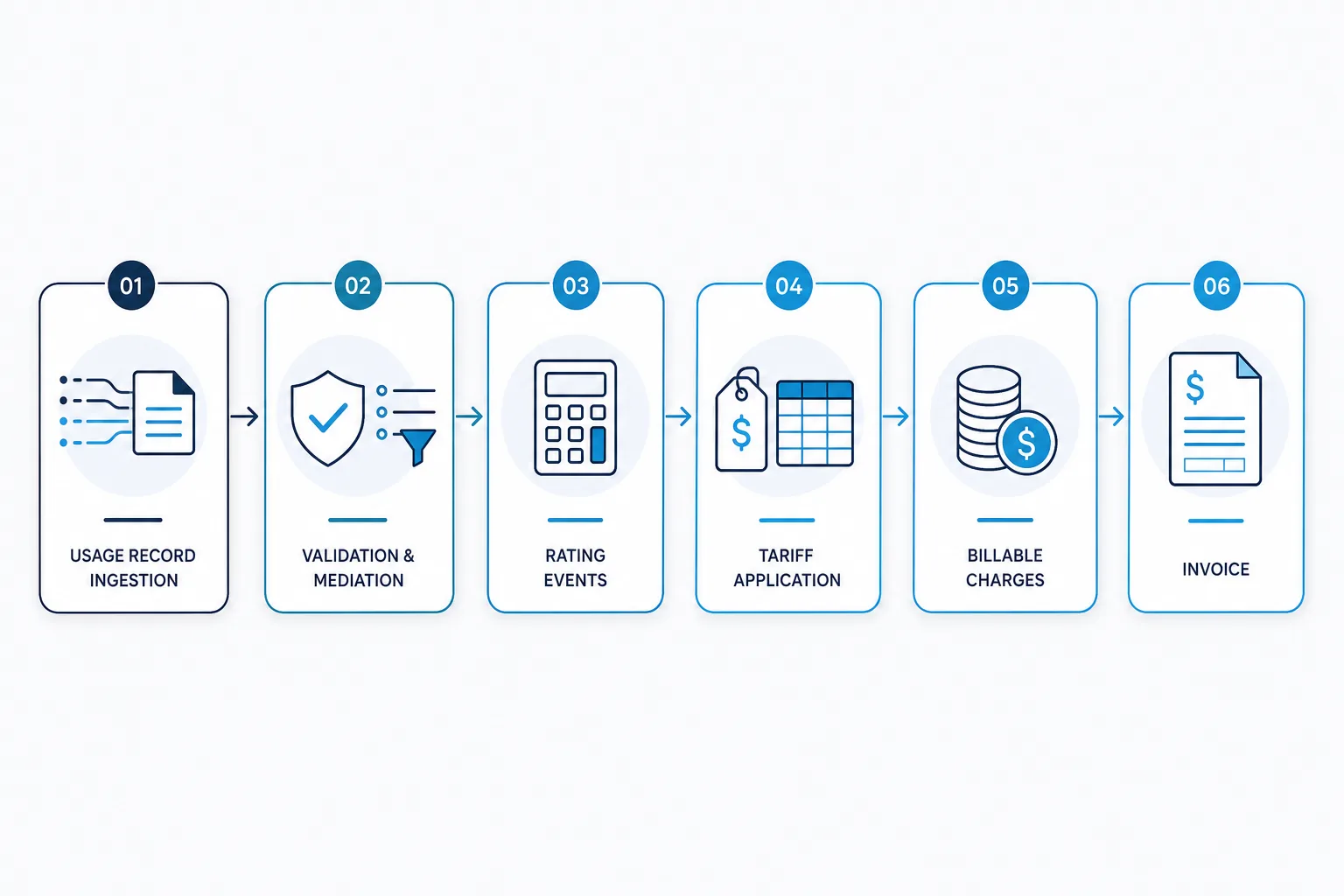
At this stage, the platform should validate required fields, reject duplicates, flag malformed records, and normalize data into a format the billing engine can use. This handoff is important because billing teams should not have to repair raw network data manually before every billing run.
Rate events
Once records are clean, the platform must rate events. Rating means calculating the chargeable value of a usage event based on duration, volume, destination, time, plan, customer segment, roaming zone, partner agreement, or another rating dimension.
For example, one voice event may be rated by duration and destination. A data session may be rated by consumed volume. A wholesale or partner event may need a different commercial rule from the retail customer charge.
Apply tariffs
Tariffs turn rated usage into commercial logic. They define what the customer or partner should pay under a specific plan, bundle, discount, commitment, overage rule, or contract.
A modern CDR billing platform should let teams change tariffs without long development cycles. Telecom offers change often, and the billing system must support that pace.
Generate billable charges
After rating and tariff logic are applied, the platform creates billable charges. Those charges must be traceable back to the original records so teams can explain invoices, resolve disputes, rerate corrections, and support revenue assurance.
This is also where CDR billing connects with invoicing, tax, payments, customer account management, and reporting.
Ready to get started?
Learn how your business can thrive with Tridens Monetization.

What telecom operators should evaluate
A strong CDR billing platform should do more than import files. It should support the way telecom revenue is actually built.
Real-time or near-real-time charging is important when operators need current balances, spending controls, prepaid services, or fast customer visibility. Batch billing can still work for some scenarios, but delayed rating makes it harder to catch problems early.
Flexible pricing is just as important. Telecom billing often combines subscriptions, usage, bundles, discounts, commitments, partner settlements, and one-time fees. If the platform can only handle one simple usage model, it will become a constraint.
Auditability is another key requirement. Teams need to see how a charge was created, which tariff applied, whether the record was corrected, and whether rerating changed the final amount.
Finally, the platform should integrate through APIs with OSS/BSS, CRM, ERP, payment, self-care, and reporting systems. CDR billing rarely works well as an isolated tool.
CDR billing platform vs telecom billing software
CDR billing platforms and telecom billing software overlap, but they are not always the same thing.
A narrow CDR billing tool may focus on importing records, rating calls, and producing usage charges. That can solve a specific problem, especially for VoIP or smaller telecom use cases.
Telecom billing software is broader. It should also manage product catalogs, subscriptions, customer accounts, invoices, payments, taxes, revenue recognition, partner models, self-care, and reporting.
For operators modernizing legacy systems, the better question is not only whether a tool can process CDRs. It is whether it can connect CDR billing with the full revenue lifecycle.
Common problems legacy CDR billing creates
Legacy CDR billing often fails in predictable ways.
Teams depend on manual checks between mediation, rating, invoicing, and finance. Offer changes require vendor work or custom scripts. Corrections are hard to trace. Revenue assurance teams spend too much time reconciling what the network recorded with what billing actually charged.
These problems get worse as operators add hybrid plans, partner offers, wholesale traffic, IoT services, or usage-based digital products. The more pricing models a telecom operator supports, the harder it becomes to manage CDR billing in a rigid system.
The goal is not just automation. It is control. Operators need to know which usage records arrived, how they were rated, which tariffs applied, what became billable, and what changed later.
How Tridens Monetization fits
Tridens Monetization can act as a CDR billing platform for telecom operators by processing usage records, rating events, applying tariffs, and generating billable charges.
It is built for operators that need more than a standalone CDR tool. Tridens Monetization supports real-time charging, no-code configuration, API-first integration, and flexible revenue models, including subscription, usage-based, hybrid, and partner models.
That makes it relevant when CDR billing is part of a wider modernization project. Operators can connect usage data with product configuration, charging, invoicing, payments, revenue recognition, and self-care instead of keeping each function in a separate legacy layer.
The practical benefit is speed and control. Billing teams can change offers, tariffs, and charging logic without waiting for every adjustment to become a vendor change request. Technical teams can integrate the platform through APIs. Finance and revenue assurance teams get clearer traceability from usage to charge.
When CDR billing belongs in the broader billing stack
A CDR billing platform should help telecom operators bill usage accurately. But it should also support how the business will change next.
If the operator only needs a call reporting tool, a narrow CDR application may be enough. If the operator needs to launch new offers, support hybrid pricing, manage partner revenue, and reduce legacy billing complexity, CDR billing belongs inside a modern revenue management platform.
That is the stronger path for telecom teams that want accurate usage billing without building another silo.
The final questions below cover the core CDR billing concepts telecom teams usually clarify before evaluating platforms.
FAQ about CDR billing platform
What is a CDR in telecom billing?
A CDR, or call detail record, is a usage record that captures details about a telecom event, such as origin, destination, duration, timestamp, service type, or usage volume.
What does a CDR billing platform do?
It processes usage records, validates data, rates events, applies tariffs, creates billable charges, and passes those charges into invoicing and revenue processes.
Is CDR billing only for voice calls?
No. The same billing principles can apply to voice, SMS, data, roaming, wholesale traffic, IoT usage, and partner events.
What is the difference between rating and charging?
Rating calculates the value of a usage event. Charging applies commercial rules and creates the amount that becomes billable.
How does CDR billing support revenue assurance?
It creates traceability from raw usage records to final charges, which helps teams find missing records, incorrect rates, duplicate events, and invoice disputes.