

SUBSCRIBE TO OUR FREE NEWSLETTER
Daily news & progressive opinion—funded by the people, not the corporations—delivered straight to your inbox.
5
#000000
#FFFFFF
To donate by check, phone, or other method, see our More Ways to Give page.
Daily news & progressive opinion—funded by the people, not the corporations—delivered straight to your inbox.
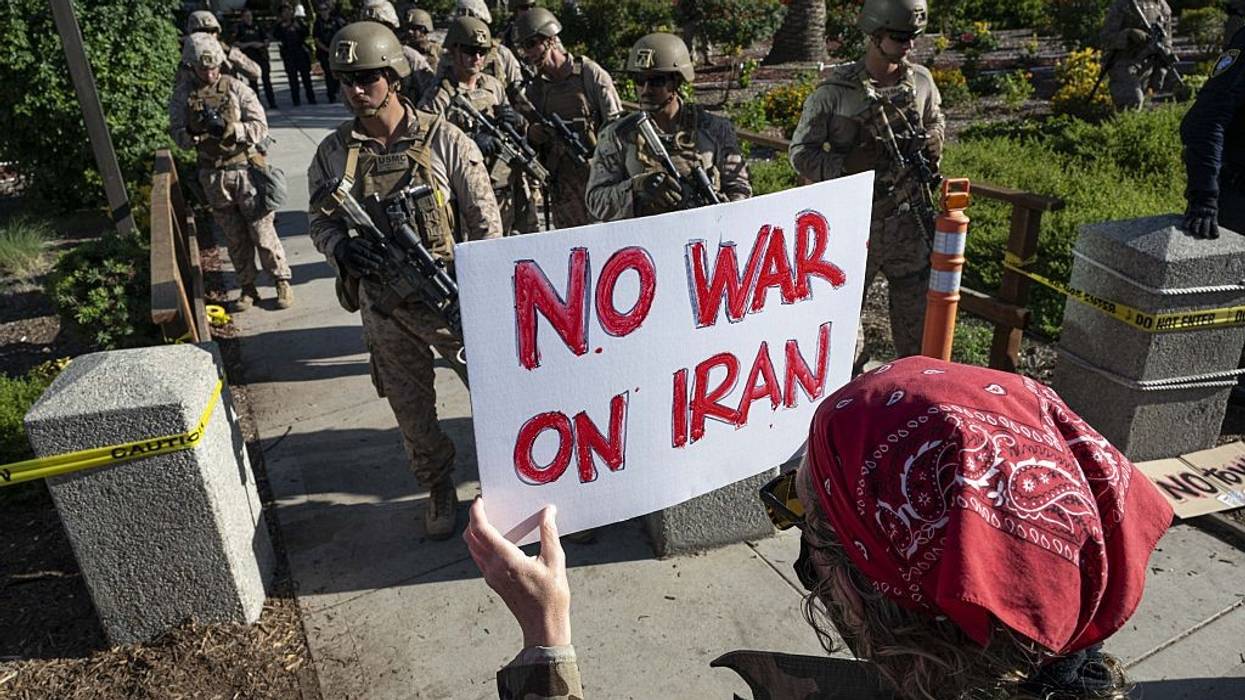
"The War Powers Resolution doesn’t give the president a 'free' 60 days—and the Constitution certainly doesn’t either," said one conservative critic.
Critics from both sides of the political aisle on Monday denounced President Donald Trump's effort to construct a facade of legality for the illegal US-Israeli war of choice on Iran by notifying Congress of renewed military strikes on the Mideast nation.
Trump claimed in a letter to members of Congress that, on July 7, he ordered "defensive strikes against targets within Iran, including missile launch sites, air defenses, military maritime assets, military support infrastructure, and command and control capabilities."
"These strikes are limited, measured, planned, and executed in a manner designed to minimize civilian casualties," wrote Trump, whose war has killed more than 3,400 people—hundreds of them children—and wounded over 26,500 others since February 28, according to Iran's Ministry of Health.
"I am providing this report as part of my efforts to keep the Congress fully informed, consistent with the War Powers Resolution," the president added.
The War Powers Resolution of 1973—also known as the War Powers Act—requires the president to notify Congress within 48 hours of committing troops to military action and limit such action to 60 days, with a 30-day withdrawal period, unless lawmakers declare war or issue an authorization for the use of military force.
Elected Democrats and legal experts have rejected Trump's argument that the negotiated ceasefire he's now abandoned resets the War Powers Resolution's 60-day limit; absent congressional authorization, the statutory clock generally starts from the first US strike and continues uninterrupted until military action ends.
Asked Monday by CNN's Kaitlan Collins if this is "just the new normal for the American people," Trump—who has called himself the "peace president"—replied, "No, well, you know, we were in Vietnam for 19 years; we're [in Iran] for four months."
Trump said during the same press conference that "we're doing another very major attack tonight" in Iran.
US Central Command (CENTCOM) said Monday that US forces "began launching the third consecutive night of strikes against Iran, at the Commander in Chief's direction."
"These strikes will continue imposing a heavy cost on Iranian forces and degrade their ability to attack innocent civilians and commercial shipping in the Strait of Hormuz," CENTCOM added.
Responding to the president's letter, former libertarian Congressman Justin Amash (R-Mich.) said on social media: "This is not how it works. The War Powers Resolution doesn’t give the president a 'free' 60 days—and the Constitution certainly doesn’t either. Regardless, we’re talking about a single war. You don’t get to pause it and then pretend it’s a different war."
Congresswoman Teresa Leger Fernández (D-NM) also took to social media, writing: "Trump said the war with Iran was over. He lied."
"Now he is telling Congress the United States is at war again—and claiming another 60 days to wage it without congressional approval," she added. "He cannot end a war on paper to dodge the law, then restart the clock when it suits him. No more lies. No more endless wars."
Aaron Fritschner, Rep. Don Beyer's (D-Va.) deputy chief of staff, said that Trump administration officials "may think the Congress and citizenry are extremely stupid, and they are mistaken," adding that the Iran War "is obviously illegal."
Foreign policy journalist Laura Rozen dragged what she described as "a forever war in 60-day increments."
Politico House leadership reporter Riley Rogerson asked House Minority Leader Hakeem Jeffries (D-NY) whether Democrats are planning on pursuing another war powers resolution like the one passed last month by both chambers of Congress aimed at blocking Trump's ability to keep attacking Iran.
"We have advanced multiple war powers resolutions up until this point, and we will continue to use every legislative tool available to end Donald Trump and the Republican reckless and costly war of choice in Iran," Jeffries replied.
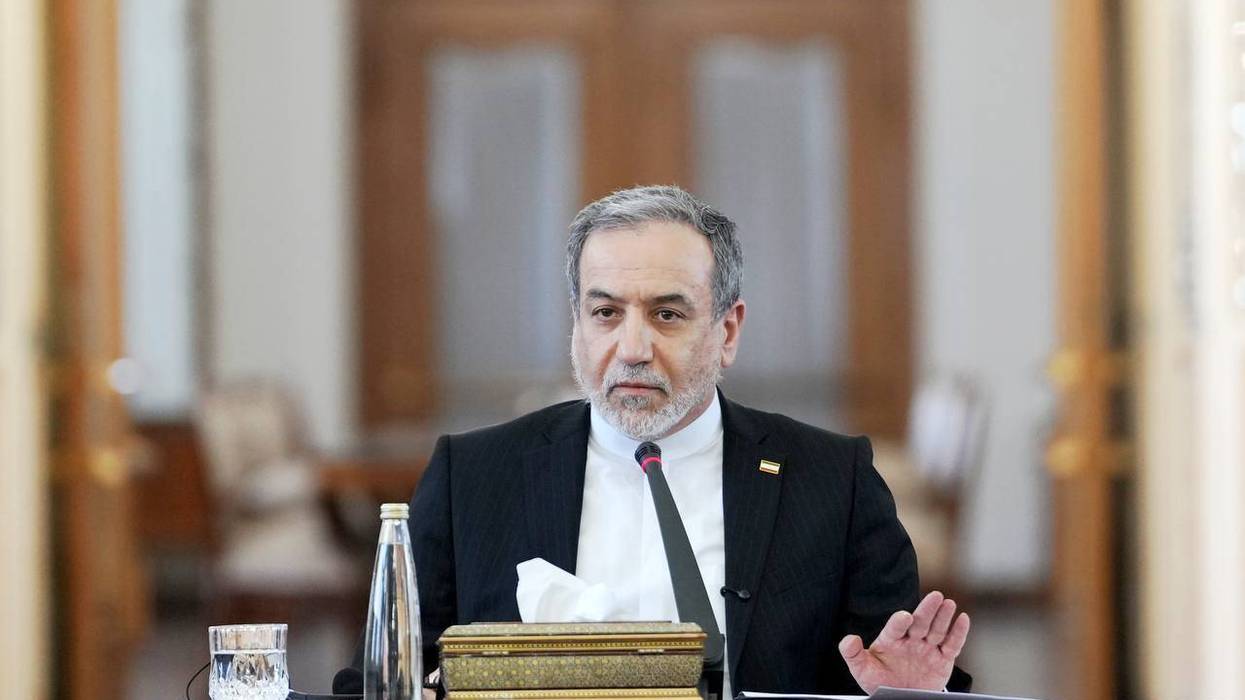
Just weeks after Trump's secretary of state admitted that "no country is allowed to charge tolls or fees on an international waterway," the president demanded 20%, far higher than the 1-2% sought by Iran.
The Iranian foreign minister on Monday mocked President Donald Trump's announcement that he was renewing the US blockade of Iran and that he expected a 20% fee from commercial vessels for "guarding" the key waterway.
"POTUS is absolutely right," the minister, Seyed Abbas Araghchi, wrote on social media. "Whoever provides secure and safe passage of commercial vessels through the Strait of Hormuz should be compensated for this service."
"Iran has always been the GUARDIAN of the Strait and will remain so FOREVER," he added. "20% is of course too much. We will be fair."
Trump had called in to "Fox & Friends" on Monday. He said on-air that the United States would be "the guardian angel of the strait" and "we're gonna get paid for guarding it."
Later Monday morning, he had written on Truth Social that "the U.S.A. will be, from this point forward, known as ‘THE GUARDIAN OF THE HORMUZ STRAIT,’ but as such, and as a matter of FAIRNESS, will be reimbursed, at the rate of 20% on all cargo shipped, for any and all costs necessary to do the job of providing safety and security to this very volatile section of the World."
Critics and experts have highlighted that Trump's 20% toll is far higher than the 1-2% sought by Iran, and warned that Trump had perhaps unintentionally bolstered Iran's case for imposing its own fee on ships in the strait.
Others have pointed out that US Secretary of State Marco Rubio told journalists just a few weeks ago that "no country is allowed to charge tolls or fees on an international waterway. That's existing international law. That's the way it is in international waterways all over the world, and that's the way we expect it'll be here. So I don't think we have anybody to convince around here in that regard. I think all the countries in this region would agree with us."

"Is the secretary of state worried because he knows US personnel committed war crimes in Iran?"
US Secretary of State Marco Rubio on Monday announced what he characterized as a "campaign to dismantle" the International Criminal Court, the Hague-based tribunal tasked with investigating and charging individuals with war crimes and other violations.
In a video posted to social media, Rubio accused the international court of "waging a war against our country—not with bullets or missiles, but with statutes, compacts, and the force of so-called international law." The top American diplomat threatened that the US "will teach the ICC the full meaning of American resolve."
The US State Department said in a statement that Rubio's new campaign against the ICC would "feature a whole-of-government response to systematically disable" the court's "ability to operate, target American servicemen or officials, or otherwise threaten American sovereignty." The US is not party to the Rome Statute, the 1998 treaty that established the ICC.
US President Donald Trump and his subordinates, who have been accused of myriad violations of international law, have adopted an increasingly aggressive posture toward the ICC since taking power last January.
In a February 6, 2025 executive order, Trump declared "a national emergency to address" the purported "threat" posed by the ICC and announced sanctions against court officials, including its judges. The president's order cited the ICC's "investigations concerning personnel of the United States and certain of its allies, including Israel," which is also not party to the Rome Statute.
In November 2024, the ICC issued arrest warrants against Israeli Prime Minister Benjamin Netanyahu and his former defense minister, Yoav Gallant, for alleged war crimes committed in the Gaza Strip.
Rubio warned in an op-ed in The Wall Street Journal on Monday that US officials accused of international crimes could be next to face ICC action.
"Border Patrol agents working to remove violent criminals from our country, US Marines risking their lives to restore order in the Western Hemisphere, federal prosecutors working to dismantle terror networks plotting attacks on the American homeland—all would face the constant risk of persecution for the 'crime' of defending our country," Rubio wrote. "Using all the tools at our government’s disposal, working beside every ally with whom we can make common cause, we will dismantle the ICC—brick by brick, if necessary."
Raed Jarrar, advocacy director of the human rights group Democracy for the Arab World Now (DAWN), said in response to Rubio's op-ed that "when the world’s most powerful country aims to dismantle the world’s only permanent international court, it sends the message that the powerful are above the law."
"It is not the ICC that Rubio is dismantling brick by brick, but the rules-based international order that grew out of the ashes of World War II,” said Jarrar. "Rubio’s attack doesn't just underscore US hypocrisy, but undermines access to justice across the globe, from Ukraine to Sudan and could amount to obstruction of justice, a crime under the Rome Statute in and of itself."
In his op-ed, Rubio pointed to DAWN's call earlier this year for Iran and other Middle East nations to grant the ICC jurisdiction to investigate apparent war crimes committed during the conflict launched in late February by Trump and Netanyahu.
Omar Shakir, DAWN's executive director, said Monday that Rubio mischaracterized the group's call as focusing solely on actions by US personnel. That move, said Shakir, "begs the question: Is the secretary of state worried because he knows US personnel committed war crimes in Iran?"
Under Rubio's plan, the State Department is threatening to impose "increased sanctions against the ICC and affiliated organizations," hit court personnel with "visa revocations and travel bans," and pressure other nations that aren't party to the Rome Statute to "leverage their diplomatic networks to take similar actions alongside" the Trump administration.
Kenneth Roth, the former executive director of Human Rights Watch who has demanded international accountability for the Trump administration over its illegal assault on Iran, wrote Monday that Rubio "can't even make an honest case for attacking the International Criminal Court."
"He makes it sound like the ICC acts out of the blue anywhere it wants when in fact it acts only against crimes committed on the territory of states that have invited it," Roth wrote. "He never explains why the United States should be able to commit crimes on the territory of those states with impunity, contrary to the desire of their sovereign governments for an international backstop to reinforce justice for such crimes."
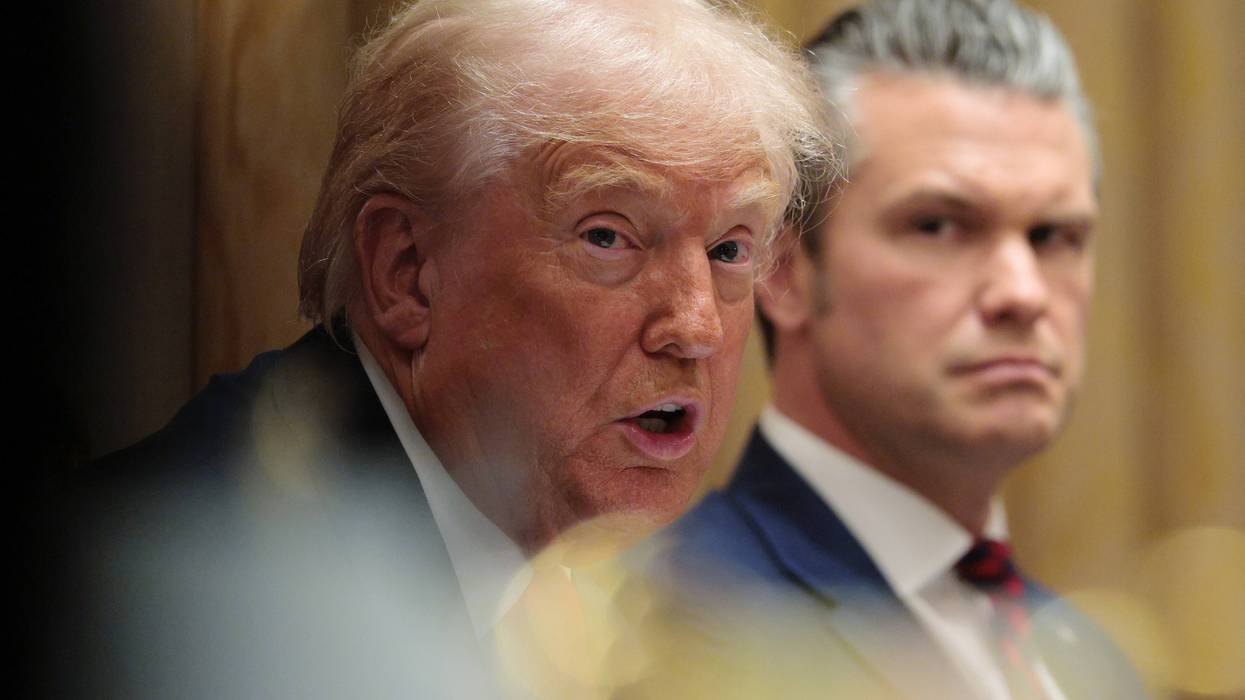
“The $1.5 trillion Pentagon budget request represents more than $9,000 per individual taxpayer."
As the Republican-controlled US Congress advances President Donald Trump's requested $1.5 trillion budget for "rebuilding" a military that's already more powerful than any armed force in human history, a group of former national security officials is urging Americans to challenge "out of control" Pentagon spending.
On Monday, the Eisenhower Media Network published a full-page advertisement in USA Today written by EMN executive director and retired Maj. Gen. Dennis Laich decrying what he called a military budget "of the Pentagon, by the Congress, and for the War Profiteers."
Invoking Thomas Paine's 1776 essay "Common Sense" and former Republican President Dwight D. Eisenhower's repeated warnings about the dangers of the then-burgeoning military-industrial complex, the ad asserts that "time and reason strongly suggest that the US 'defense' budget is out of control, unsustainable, and absent of accountability."
"Only the American people can rein it in," Laich argued.
The advertisement notes that the US military budget is already "larger than the next eight nations (most of whom are allies) in the world combined, while American citizens lack healthcare, childcare, and other basic needs."
The ad continues:
The defense industry’s lobbyists team up with US politicians, who receive campaign financing from the industry, to draft the annual National Defense Authorization Act, which sets military policy, the expensive weaponry to be purchased, and the overall military budget. The industry takes the ensuing windfall and puts it toward stock buybacks, which increase the share price, making the rich richer; dividend payments for shareholders; eight-figure annual compensation packages for corporate executives; and the continual political graft (campaign contributions and lobbyists) that keeps the wheel spinning. Incredibly, some contracts stipulate that only the contractor may repair and maintain equipment. The most embarrassing example of this practice is the F-35 stealth fighter, which is grossly over budget, behind schedule, and is only 25% fully mission capable.
"Money talks in America, but few members of Congress choose to talk about the $39 trillion national debt to which military spending is a major contributor," Laich wrote.
"Additionally, the Pentagon cannot tell the American taxpayer where the money went, since it is unable to pass a financial audit as required by law—something every other department of the federal government is able to do," the ad notes. "Now, they are requesting a 50% increase in the defense budget to $1.5 trillion. This is equivalent to your child asking for more money a day after receiving his/her allowance. When you ask what happened to the money he/she received yesterday, the child can’t answer the question, but yougive him/her more money regardless."
Laich accused "uniformed bureaucrats" of lacking "the courage to stand up against a draft dodger and a Rambo-wannabe," an apparent swipe at Trump and, perhaps, Defense Secretary Pete Hegseth.
Meanwhile, despite having the best-funded and most powerful military on paper, the ad points out that since World War II, "the US has won one war (the first Gulf War), lost four (Vietnam, Iraq, Afghanistan, and Iran), and tied one (Korea). Iran may be as much an embarrassment as a loss. The United States has failed to achieve its stated objectives in any recent war."
The ad asks, "What football coach could keep his job with a 1-4-1 record?"
"The $1.5 trillion Pentagon budget request represents more than $9,000 per individual taxpayer," EMN said. "If we Americans are tired of seeing our tax dollars spent on endless wars, bombing campaigns, and military excess while our own communities struggle with the costs of healthcare, childcare, education, and infrastructure, then the time has come to do what Thomas Paine asked Americans to do 250 years ago: challenge the assumptions that have become accepted simply because they are old."
"The courage required today is not to defeat an empire abroad, but to confront one at home—the military-industrial-congressional complex—and reclaim a government that serves the American people rather than the interests of perpetual war," the ad concludes.
EMN's advertisement follows an ad released by Hegseth in May touting Trump's $1.5 trillion proposal, which would add nearly $7 trillion to the US national debt over the next decade, according to the nonpartisan watchdog group Committee for a Responsible Federal Budget.
A survey conducted in May by ReThink Media and the Costs of War Project at Brown University's Watson Institute for International and Public Affairs revealed that nearly 60% of Americans believe the proposed Pentagon budget is too large, including 40% who say $1.5 trillion is “much too high” to spend on the military.
Last month, US Sen. Ed Markey (D-Mass.) introduced the Slash the Pentagon Act, which would set a hard cap of $750 billion on the amount Congress could authorize for national defense spending in fiscal year 2027.
"As Americans struggle to pay for healthcare, rent, electricity, groceries, and gas... Trump has spent over $100 billion on his expensive, dangerous, and unnecessary war with Iran," Markey said at a Capitol Hill press conference introducing the legislation. “We should invest in our hospitals, schools, affordable housing, and the real security American families need right now—not expensive wars and weapons that make us less safe.”
