

Sol's stage in Guilty Gear.
Stage (ステージ, Sutēji?), also referred to as backgrounds,[1] are locations where battles occur in fighting games like the Guilty Gear series. They force two characters to engage in close combat as their boundaries are fixed. All characters have a specific stage that they are associated with.
Overview[]
With the exception of Guilty Gear 2 -Overture-, stages are a simple 2D screen that force characters to face each other and limit the player's range of movement with invisible walls, i.e. the edge of the screen; in Strive, contact with them will cause a circular blue seal to appear behind a character. Since the original Guilty Gear,[2] battle venues can be selected only in Versus Mode and Training Mode during Character Select;[1] in Story and Arcade Modes, the background will depend on the computer-controlled opponent. The means of selection varies by game.
For most of the series, there is little interaction between characters and stages. One such is the Wall Stick state, introduced in Guilty Gear XX Λ Core, in which characters may stick to the wall before sliding down to the ground, leaving them open to attacks. Boundaries are also involved in some moves, like Sol's Riot Stamp or Chipp's Wall Cling/Run skill.

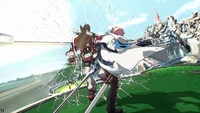
A wall-break in Strive.
In Strive, stage mechanics have been revised. Each stage is now comprised of several distinct areas, and players transition to a new section via Area Shifts, flying a long distance between each. There are two ways to cause this. The first is by using a Dust Attack, following it with a Chase Jump and an aerial combo, at the end of which the area has changed. The other is to cause a Wall-Break, in which characters get stuck to the wall for a bit but continued damage will shatter it, giving the attacker a Positive Bonus.[3]
Details[]
Guilty Gear[]
In Guilty Gear, each character has a stage, for a total of thirteen. Although some would be revisited in following entries, all stages are unnamed in this iteration, simply identified by the character they belong to.
Guilty Gear X[]
A few stages return, and five new original ones are added, for total of ten stages. The Advance Edition re-uses the same stages, if simplified by technical limitations. Two more backgrouns (Grave, Heaven) are re-added in Guilty Gear X Plus.
Guilty Gear XX[]
To the previous twelve stages, four more stages are added in XX. Slash adds three new stages, and provides new versions of preexisting stages. With yet another graphical update in Λ Core Plus, players can access ♯Reload and Slash versions after completing each associated character's Story Mode.
Guilty Gear 2[]
Overture stages are as follows: Triora, Underworld Hill, Ganymede, Illyria, Bel Canto Valley, and Holy Knights' Fortress, which was a DLC release alongside EX Sol in the console version; it is available by default in the Steam version.
Guilty Gear Xrd[]
There is a total of twenty-two stages, five of them shared by two characters, and a special Arena that has no assigned character.
Guilty Gear -Strive-[]
On release, Strive had ten stages, but nine more have been released as downloadable content since. All stages have at least three areas where matches take place.
Other[]
The Petit games adapt all stages from Guilty Gear X, except those added in X Plus. Guilty Gear Isuka and Judgment features almost entirely new sets of backgrounds. Like in Petit, those in Dust Strikers are mostly repeated from Guilty Gear X, although with a few additions.
Trivia[]
- Unlike in other installments of the series, battle themes in Guilty Gear Isuka are associated to stages rather to the characters themselves. However, the cast have their own stages assigned and so share the theme.
Gallery[]


References[]


