

SUBSCRIBE TO OUR FREE NEWSLETTER
Daily news & progressive opinion—funded by the people, not the corporations—delivered straight to your inbox.
5
#000000
#FFFFFF
To donate by check, phone, or other method, see our More Ways to Give page.
Daily news & progressive opinion—funded by the people, not the corporations—delivered straight to your inbox.
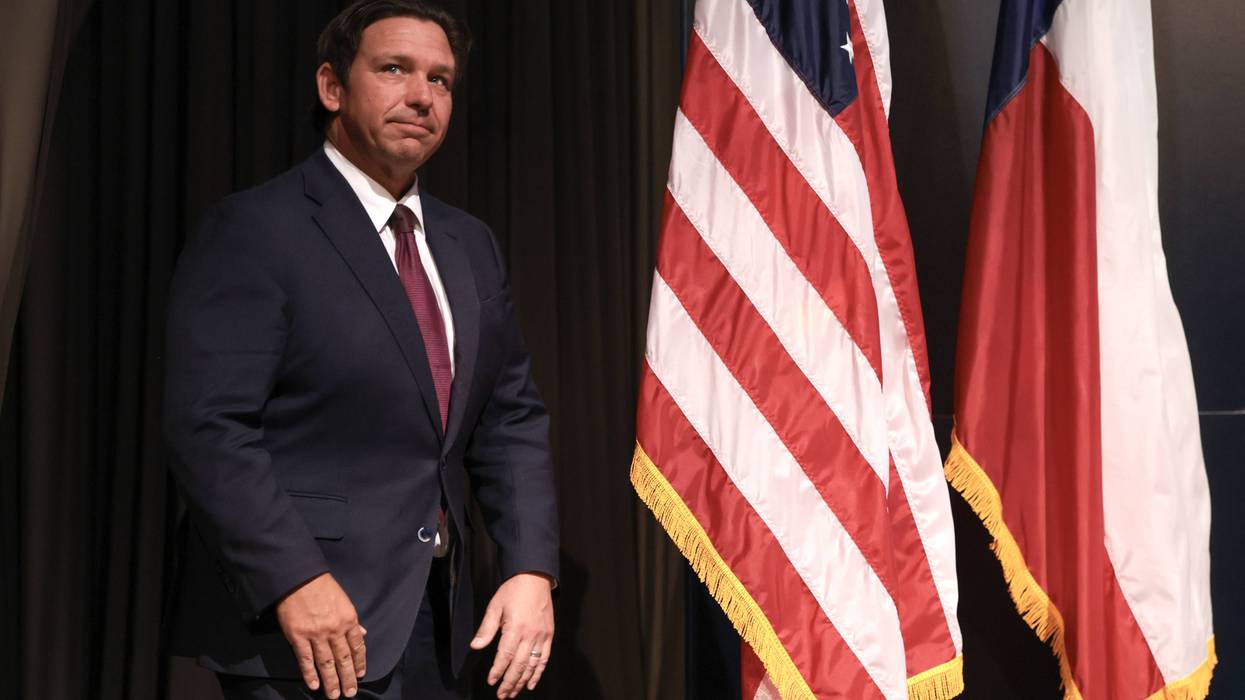
Florida's constitution explicitly bans partisan gerrymandering. But a court full of DeSantis appointees just upheld maps that give the GOP 24 of the state's 28 seats with no time to reverse it before November.
In defiance of state law and the will of voters, the Florida Supreme Court has handed Republicans another major win in the redistricting wars in time for this year’s midterms, approving a ruthlessly gerrymandered map that could hand another four US House seats to the GOP.
Florida’s state constitution is unusually explicit in its ban on partisan gerrymandering; the Fair Districts Amendment (FDA) approved in 2010 by 63% of voters expressly states that maps may not be drawn “with the intent to favor or disfavor a political party or an incumbent.” The court has struck down previous attempts by Republicans to draw more favorable maps on these grounds as recently as 2015.
But six of the seven justices that make up the current court have been appointed by Florida’s Republican Gov. Ron DeSantis. And when voting rights groups challenged a new map signed by the governor last month that is projected to give Republicans an advantage in 24 of the state’s 28 House districts, the right-wing court gave DeSantis what he wanted.
By a 6-1 ruling, the court on Wednesday declined to rule on the merits of the case, denying opponents' request for an emergency injunction, with the majority arguing that, despite the rapidly approaching election, this was not enough of a reason to rule on it while it's still being reviewed by a lower court.
The lone dissenter, Justice Jorge Labarga, who happens to be the only justice not appointed by DeSantis, argued that the case could be reviewed under the court's "pass-through" provision, which allows the court to expedite rulings on matters of great public importance.
"Surely," he said, "the upcoming 2026 congressional elections affecting the representation of millions of Floridians meet that threshold.”
With the state’s primaries set for August 18, this virtually guarantees that, despite its unconstitutionality, the map will be in place come November, as Republicans across the nation try to "pack and crack" enough Democratic strongholds to cling to control of the House in 2026.
In a post to social media, Florida's Republican Attorney General, James Uthmeier, celebrated the order as a “COMPLETE AND TOTAL VICTORY.”
The Florida Supreme Court has REJECTED the challenge to the state’s redistricting plan and new map.
This assures that the recently enacted map will be in place for the 2026 election.
— Ron DeSantis (@RonDeSantis) June 10, 2026
Opponents of the map—including Common Cause, the League of Women Voters, and the League of United Latin American Citizens—have said that the governor has made no effort to hide the overtly partisan nature of his redistricting push, which he carried out rapidly under an emergency session of the state legislature without public input.
In their lawsuit last month, they pointed out that the governor himself provided a color-coded version of the map to Fox News to highlight projected GOP gains—although Republicans won just under 57% of votes in House elections across Florida in 2024, they’d be expected to control nearly 86% of seats under the new maps.
Meanwhile, Jason Poreda, a senior DeSantis adviser who has described himself as the map's "drawer" has acknowledged that he used "partisan data" to draw the map in spite of the FDA.
As is the case with many of the maps drawn to maximize GOP power, DeSantis' cracks up majority-minority districts, including one predominantly Black district in Palm Beach and Broward County, and splinters the Orlando-Kissimmee area's Latino community across four districts.
And here is the new Florida congressional map in Dave's Redistricting: https://t.co/fTqDHjncwz pic.twitter.com/UTxflFazT0
— The Redistrict Network (@RedistrictNet) June 10, 2026
“The fact that this is a partisan gerrymander is as obvious as it is unconstitutional,” said Bradley Heard, deputy legal director of the Southern Poverty Law Center, which represented the plaintiffs last month. “And while this unnecessary map is egregious in how it advantages Republicans and disadvantages Democrats, the people who will suffer the most if it is allowed to stand are once again Black and Brown communities, whose voices are consistently silenced in these redistricting battles."
Florida Circuit Judge Joshua Hawkes, a DeSantis appointee who upheld the maps last month, declined to weigh in substantively on the question of whether the new map violated the FDA, but said it was more in line with the maps favored by the US Supreme Court in the recent Louisiana v. Callais decision, which struck at the heart of the Voting Rights Act of 1965 by effectively ending protections for districts drawn to give representation to nonwhite voters.
While Hawkes also did not weigh in on Republican arguments that the entire FDA should be thrown out because of Callais, he said it was ultimately fine for the court to defer ruling on DeSantis' map because "to the extent the court has to balance Florida’s FDA prohibition of improper partisan intent and the United States Constitution’s Equal Protection guarantees, it seems clear that the potential partisan intent is the lesser of the two evils."
The Callais decision has given Republicans a decisive upper hand in the redistricting wars that were kicked off last year when President Donald Trump called on red states to enact unprecedented hyperpartisan gerrymanders in an effort to beat back an expected Democratic wave in 2026.
An aggressive and explicitly racial gerrymander in Texas enacted without voter approval was upheld by the US Supreme Court last month, netting the GOP an expected five seats, and six other red states have redrawn maps to likely squeeze in one new Republican seat apiece.
And while GOP gains have been somewhat offset by California voters' approval of an amendment to allow Democrats to draw their own hyperpartisan maps, the US Supreme Court's refusal to stop the Virginia state supreme court from striking down of a voter-approved Democratic gerrymander dealt a critical blow to efforts to even the score, and Democrats have vanishingly few opportunities to make up ground before the coming midterms.
Florida Republicans blatantly violate their constitution and brutally gerrymander their map without a single vote = 100% legal.
Virginians vote to change their constitution so they can temporarily offset right wing gerrymandering = 100% illegal.
America is a banana republic. https://t.co/vTer29RSqQ
— Micah Erfan (@micah_erfan) June 11, 2026
Florida represents yet another notch in the win column for Republicans, but opponents say they will attempt to fight the gerrymander ahead of future elections.
"The Florida Supreme Court's failure to stop this brazen partisan power grab is not only an assault on democracy, but an abdication of its duty to the people of Florida," said Genesis Robinson, the executive director of the voting rights group Equal Ground. "Courts are meant to serve as a check on government overreach and a safeguard against constitutional violations, but, once again, when Floridians needed that protection most, the court declined to intervene."
"The time to protect voters from irreparable harm is before another election takes place under this map," he added. "And while we remain committed to ensuring that Florida's constitutional protections are fully upheld, Florida voters deserve fair maps, fair representation, and a democracy that works for everyone now."
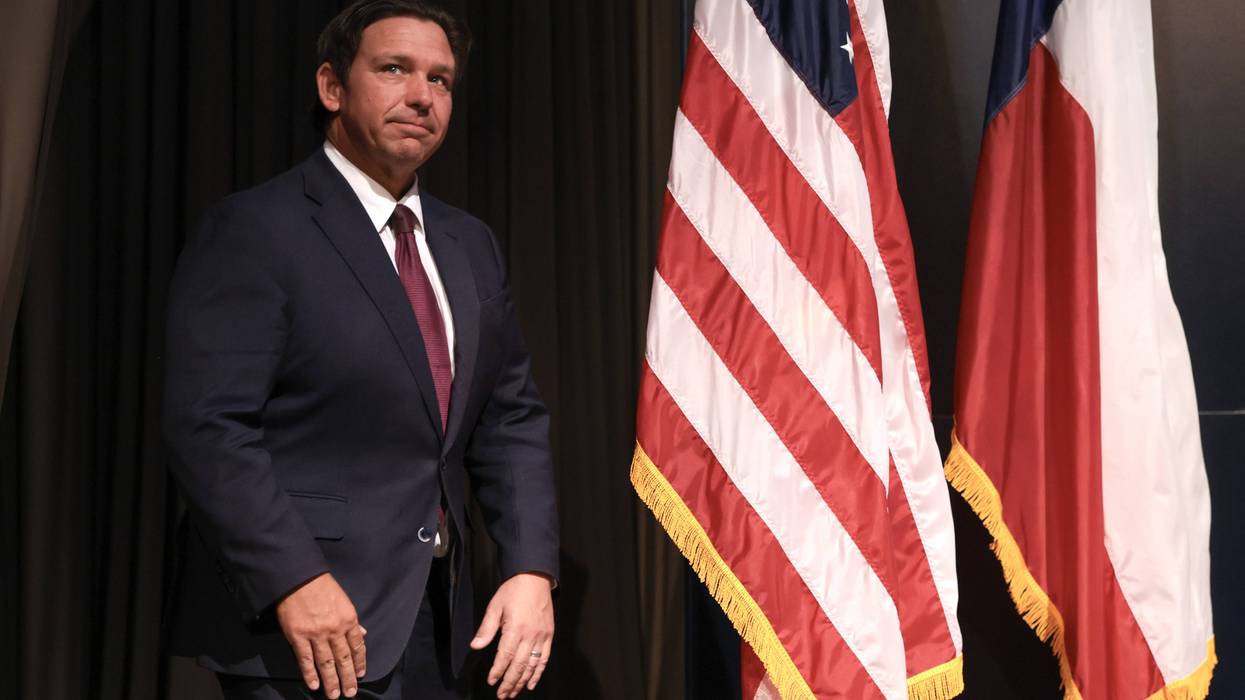
"This should be a clear-cut case, and all Floridians should see justice for this blatant attempt to reduce their rightful voting power even more than before," said the head of one voting rights group.
As Republican Florida Gov. Ron DeSantis on Monday did his part to advance President Donald Trump's gerrymandering spree by signing a rigged congressional map into law, state voters swiftly sued over the newly drawn districts.
"Signed, Sealed, Delivered," DeSantis posted on social media Monday, celebrating Florida's new US House of Representatives map that's expected to give the GOP a 24-4 advantage, up from 20-8. It's part of Trump's campaign to redraw districts in various Republican-governed states in hopes of keeping control of both chambers of Congress.
Meanwhile, Floridians supported by the National Redistricting Foundation (NRF) and the Equal Ground Education Fund filed a lawsuit against the state Legislature and Secretary of State Cory Byrd over the map in the Circuit Court of Leon County.
"In 2010, the people of Florida voted overwhelmingly to enact the Fair Districts Amendment to the state's constitution, imposing constraints on the worst abuses of congressional redistricting and entrusting the Florida judiciary to enforce those safeguards," notes the complaint, which goes on to highlight a map tossed out by the Florida Supreme Court in 2015.
The filing also lays out the current battle initiated by Trump last year: He pressured Texas Republicans to redraw their state's US House map. North Carolina and Missouri's GOP leaders followed suit, prompting voters in California and Virginia to support drawing new districts that favor Democrats, who aim to reclaim congressional majorities in the November midterm elections.
The complaint then lays out DeSantis' monthslong push to redraw Florida's districts to appease the increasingly authoritarian president, in violation of the state constitution. It stresses that recent "changes to Florida's congressional plan come on the heels of a 2022 redistricting plan that already substantially advantaged Republicans."
The state's new map "is, by traditional measures of partisan gerrymandering, one of the most extreme gerrymanders in American history," the document declares. It was "made by professionals with sophisticated tools and a clear partisan goal: to pack and crack Democratic voters with surgical precision and deprive Florida voters of a fair map guaranteed to them by the Florida Constitution."
The Democratic and unregistered Florida voters behind the case, who live in various districts, asked the court to block the latest rigged map from being used in this year's election and strike it down completely.
"Florida's mid-decade gerrymander is a blatant violation of the state's constitution," said NAF executive director Marina Jenkins in a statement. "This map is a gerrymander on top of an already egregious gerrymander that cracks apart numerous districts in nonsensical ways with the intent to favor one party over another."
"Given the clear violations of state law, this should be a clear-cut case," Jenkins added, "and all Floridians should see justice for this blatant attempt to reduce their rightful voting power even more than before."
The plaintiffs are represented by the Orlando-based firm King, Blackwell, Zehnder, & Wermuth as well as Elias Law Group, which was founded by Democratic election lawyer Marc Elias.
Nikki Fried, chair of the Florida Democratic Party, and US House Democratic Majority Leader Hakeem Jeffries (D-NY) also spoke out against the new state map on Monday.
"The lame-duck governor of Florida is auditioning for Donald Trump's undying love after his presidential aspirations were crushed in 2024," Jeffries said in a statement. "Democrats have brutally thwarted the MAGA midterm power grab, and we will continue to push back aggressively. Today, less than a week after corrupt Republican legislators approved an unconstitutional partisan map leaked to a right-wing news outlet, Ron DeSanctimonious signed it into law."
"By his own lawyer's admission, these boundaries were drawn with partisan intent, a shameless disregard for Florida voters who overwhelmingly passed the Fair Districts Amendment to bar political favoritism and incumbent protection in 2010," Jeffries emphasized. "Ron DeSantis knows this gerrymander is a direct violation of Florida law."
As Politico reported Monday
A top aide for the GOP governor acknowledged last week that he relied on political data as part of his map drawing effort—a potential violation of "Fair Districts" standards.
Attorneys for DeSantis contended that these anti-gerrymandering standards no longer needed to be followed because the state Supreme Court last year ruled that the minority voter protections that were also part of the same amendment did not need to be strictly followed. They said the amendment was a "package" that could not be broken apart.
DeSantis and his Republican allies have also cited Florida's growth as a reason to redraw the lines, but the new map relies on the same 2020 US Census data that was used in the current map, which has been approved by both state and federal courts.
The fight playing out in Florida comes after the US Supreme Court last week gutted the remnants of the Voting Rights Act in a battle over Louisiana's congressional map that preceded Trump's gerrymandering campaign. Republican Louisiana Gov. Jeff Landry responded by suspending a primary election already underway, sparking lawsuits from civil rights groups and voters.
"If they think they can get away with trampling over the will of the voters and ignoring the state constitution’s ban on partisan gerrymandering, they are sorely mistaken," said one voting rights advocate.
The Florida state Legislature on Wednesday passed Gov. Ron DeSantis' proposed redrawn congressional map aimed at netting four new seats for Republicans in the 2026 midterm elections—but voting rights organizations are vowing to fight back.
As reported by Politico, the map was "approved largely along partisan lines, even though a handful of GOP state senators voted no," while "Democrats maintained the map was illegal because it runs counter to voter-approved, anti-gerrymandering standards in Florida."
However, Politico noted that "the new map is also destined to trigger a messy legal battle that could play out in both state and federal courts," and voting rights groups are ready to put up a fight.
John Bisognano, president of the National Democratic Redistricting Committee (NDRC), slammed DeSantis for drawing up what he described as an "extreme new gerrymander" that "was drawn behind closed doors because he knows the voters overwhelmingly oppose this partisan power grab."
Just because the map passed the state Legislature, Bisognano added, that doesn't make it a done deal.
"If they think they can get away with trampling over the will of the voters and ignoring the state constitution’s ban on partisan gerrymandering, they are sorely mistaken," he said. "This fight is not over, and Florida Republicans can expect fierce legal challenges against this new gerrymander."
Brad Ashwell, Florida director at All Voting is Local Action, argued that the new map was just the latest example of DeSantis trying to suppress voters in the state.
"DeSantis’ legacy will always be tied to the erosion of voting rights in Florida," he said. "The ridiculous creation of an election police force, the laws that attacked popular voting methods like voting by mail and early voting, and now mid-decade redistricting—all have been used to keep voters from the ballot box and control the results of our elections."
Brett Edkins, managing director of policy and political affairs at Stand Up America, described the new Florida map as "a desperate attempt to rig the 2026 midterms and protect [President] Donald Trump and his sycophants in Congress," and he warned of political consequences for the GOP.
"While these new maps will make it harder to hold Trump and Congress accountable, in America, power rests with the people," he said, "and the people will not forget this assault on their freedom to vote in November."
Trump in 2025 sparked an unprecedented mid-decade redistricting battle when he pushed Texas to redraw its congressional map to gain extra Republican seats, and GOP-led states North Carolina and Missouri soon followed suit.
However, Democrats in California and Virginia struck back with their own redrawn maps that are backed by those states' voters and projected to nullify the advantage Republicans hoped to gain with their mid-decade gerrymandering gambit.
